

“Type B” Organizing Helps Both You and Your Home Function Better
Perfectionist coaches and pro organizers agree: Comfortable systems tailored to your life and needs are essential to well-being and making the most of your spaces.

Shutterstock/Josep Suria

So-called “Type B” personality traits — like being flexible, patient and relaxed, as opposed to hard-charging “Type A” traits like pursuing perfection at all costs — are having a moment. Scientists have long known the A/B binary is an artificial one, since we’re all combinations of characteristics. That said, dreaming of being more “Type B” is pretty understandable when you’re feeling burned out.
Here's the good news beyond the pseudoscience: Taking a more flexible, patient and relaxed approach to your home has real, tangible benefits that can make both it and your overwhelmed headspace more pleasant places to knock around. We turned to experts for evidence-based tips on how and why to lean into “Type B” — and here’s what they advise.

Shutterstock/AYO Production
“Done” Is Better Than “Perfect”
Dr. Ellen Reed, a mental-performance coach who helps high-achievers (like executives and Olympic athletes) overcome perfectionism and reduce overwhelm, says sky-high standards result in procrastination. “We wait to start until we feel like conditions are perfect or because we are afraid our work won’t be good enough. So we put it off,” she explains. “Hence the closet or garage project that you keep saying you will tackle when conditions are ‘right,’ like when you finally have a free weekend or the money to buy every organizing product you have saved in your Pinterest board. Spoiler alert — this perfect time will never come.” You don’t need to devote 12 uninterrupted hours to your jumbled pantry; you need to open the door and get in there.
Don’t Be Precious About Products
No matchy-matchy, woven-water-hyacinth storage bins or integrated closet system? No problem. “[I]f I can grab something quickly and the presentation is reasonably attractive, I am satisfied,” says professional organizer Cynthia Kienzle, AKA The Clutter Whisperer of NYC. “I am very conservative when it comes to product. Not everything has to be in a cute basket or container. Not every drawer has to have separators. Very few things need to be labeled. Underwear and socks don’t need to be in honeycombed drawer organizers. That’s going too far, in my opinion.” As your cat might say, if it fits, it sits.
Break Tasks Into Manageable Pieces
Focusing on results creates anxiety and pressure that decreases your chances of achieving those results. Instead, Ellen advises, develop clear process goals. “For example, instead of, ‘I really need to get this basement in order,’ shift the thinking to the next process-focused step toward achieving it. For example, ‘I will spend 30 minutes this afternoon working in the basement,’ or “I will clean out one toy bin tonight.’

Shutterstock/Jaromir Chalabala
Remind Yourself of What’s Already Great
So-called “Type A” folks skip over the things they’re doing well and fixate on imperfections, both in their lives and in their homes. Ellen coaches her clients to break this cycle each day by writing down three things they’ve done well in the last 24 hours, and that intervention can be just as helpful when all you can see is, say, living-room clutter. “When you find yourself looking at your space and only seeing what you want to change, force yourself to identity 3 things you like about it. You will be surprised at the perspective shift this will give you,” she says.
Standards Should Meet You, Not the Other Way Around
Professional organizers — literally, the people who come to your house and get paid to make the moves you can’t or won’t — aren’t swapping things around to suit what they prioritize. They’re interested in what meets your needs, and you should extend yourself that respect. “If your current organizational systems are causing frustration, that is when you know it is time to revamp,” Cynthia says. “Think about how you use the items and not so much how they look in a drawer or closet. If you use bowls rather than plates to eat from, then bowls should be front and center and plates on a higher shelf. If you are right-handed but your knife block fits better on the left side of the prep counter, then switch. Don’t try to put a square peg into a round hole.”
Pay Attention to Friction
Your own feelings can also be indicators that a system isn’t working for you. “If you’re avoiding putting things away, repeatedly reorganizing the same area, or feeling frustrated by the system, that’s usually a sign it’s too rigid,” says Ashley FacioLince, a professional organizer with Urban Clarity. “A strong system aligns with your natural habits. If you always drop your bag by the door, the solution isn’t to fight that — it’s to create a landing zone there. When a system requires willpower to maintain, it’s probably not the right system.”

Robert Peterson / Rustic White Interiors
Try Visible Grouping, Not Bare Surfaces
“One of my favorite techniques for making a place more functional, while maintaining the feeling of organization, is visible grouping,” explains Michelle Byron, another Urban Clarity organizer. “In organizing, I use products like a turntable, tray, or basket to contain items on surfaces and avoid the added friction of having to open and close a door to access them. As silly as it sounds, opening and closing one door can be a big barrier when you’ve got a hundred other things on your mind.” Corralling, in other words, beats cramming things out of sight. “Visible grouping is truly the middle ground between perfectly clear surfaces and the high cognitive load of clutter.” And along those lines,
Resist the Urge to ‘Tidy As You Go’
Irresistible as it may feel to pick up and re-home stray clothes or dishes when you find them out of place, tidying steadily will take meaningful bites out of your schedule (and other priorities) all day long. “Once you do have your organization system and feel like things are in order, it can be hard to walk away,” Ellen says. “I fight this same battle myself with my email inbox when the urge arises to delete every spam email the moment it comes in. When I delete constantly throughout the day, it eats away a lot of time. Instead, I allow myself to delete emails once in the morning and once at the end of the day. I still get the urge when an errant email appears in my perfectly clean inbox, but I remind myself I will get to it at the end of the day. I take a deep breath, and then I move on.”

Shutterstock/Olena Yakobchuk
Break Rules As Needed
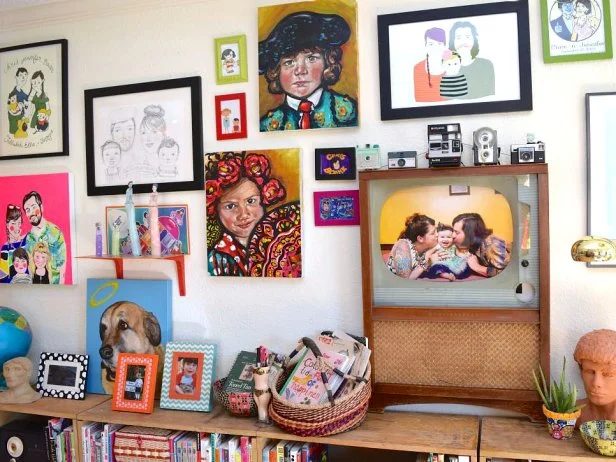
“Living and working in NYC apartments, I’ve learned that you have to use your creativity to master functionality,” says Urban Clarity organizer Anna Martin. "Take my kitchen: I have a few dishware sets, but I don’t use all of them every day. Space constraints have forced me to ignore the ‘keep sets together’ rule. My smaller bowls sit with everyday plates for easy access, while the larger bowls live on the highest shelf with serving trays. It looks organized, but the sets are separated.”
Jennifer Perkins
Remember What You Love in Others’ Homes
Worried that guests will judge your space? Michelle instructs her clients to recall what they think about they visit others’ homes. “Maybe they eventually noticed that the drapes were (or were not) ironed, but more than likely they never clocked the drapes at all and they noticed all the charming things first: The collection of colorful books and spunky tchotchkes, the view from the living room windows, and the unexpected vaulted ceiling,” she says. “Media might love portraying nitpicky mothers-in-law wiping their fingers on a dusty surface, but, in my experience, that’s fiction. Family and friends are just glad to see you and to spend time with you in your personal sanctuary.”
Know When to Step Away From the Internet…
“It is important to recognize when spaces that you see on social media are making you feel inspired versus when they are making you feel discouraged,” Ellen notes. “There is a big difference. If you feel inspired to organize your spices in the beautiful way you saw in the magazine, set a tangible process goal and have at it! If you are comparing yourself or your spaces to beautiful images you see online, it is time to walk away.” Cynthia agrees: “We need to give ourselves permission to do what is right for us and not right [for] the marketer.” We’re going to emphasize this point a third time: “When Khloé Kardashian’s pantry [above] went viral, it sparked a huge trend, but that space was stocked and arranged with presentation in mind, and it’s also the size of a small grocery store,” notes Urban Clarity organizer Ron Roberts.
…And Know When Organizing Isn’t Soothing
“Cleaning and organizing are great ways to get into a flow state, which is awesome for our nervous system,” Ellen says. But! There is a but! “If you find that organizing makes you feel more stressed instead of less, try something else as a flow activity. Other great ways of shutting down our brains are gardening, drawing, knitting, reading, walking through an antique store, or anything else that you enjoy and find yourself not checking your phone while doing it.” Now, get out there and whip your home into shape for only 30 minutes! Or not at all! We trust you to figure out what works for you.





.jpg.rend.hgtvcom.231.174.85.suffix/1738869872256.webp)