Problem: No Space to Grow
At the height of the Covid-19 pandemic in 2020, travel writer and mom of two Kim Dinan felt a deep urge to plant a garden. "I had a physical desire to get my hands in the dirt," she says. She wanted a place where she could teach her kids where food comes from, and a retreat for herself, too. The trouble on their mountainside lot in western North Carolina? No flat, sunny space in which to grow.
So Kim and her husband Brian Patton looked to an underused patch of pavement for a solution. They called up local ecological design company Gardens of Eatin to draw up a design that would include the principles of permaculture, which aims for a sustainable, self-sufficient garden. As part of that, Kim and Brian committed to doing a lot of the labor themselves, including removing the expanse of paving using rented equipment and building the raised beds.
More photos after this Ad
Before: Pavement Without Purpose
Kim, Brian and their two children weren't using the large paved area beside their house — their only available flat spot — and needed an at-home space for connecting with nature for themselves and the kids. So the pavement had to go. While they were a little concerned about losing an area where their kids would ride bikes and play, they felt like they'd gain far more than they'd lose.
More photos after this Ad
After: Welcoming Permaculture Garden
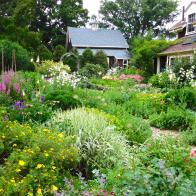
And they were right. Replacing pavement, the new permaculture garden softens the look of the house and, more importantly, provides ample space for growing annual and perennial plants that feed the family and their non-human neighbors, including pollinators and birds. "The most fun part for me is seeing the kids in the garden, because we were worried about them losing their play space," Kim says. "They’re so into it, they help us plant and harvest whatever we have. It’s the happiest part of my day."
More photos after this Ad
Overall Design Viewed From Above
A view from the deck stairs shows the shape of the garden design, with raised beds for vegetables on one side, an in-ground bed for perennial pollinator plants on the other, a bed constructed along the retaining wall for tomatoes and other vining plants, a large V-shaped herb bed with seating and flagstone pathways that lead through the space.
More photos after this Ad
Hog Wire Tomato Trellis
The upper drive and former lower drive (now the garden) are separated by a retaining wall. To mask the wall and provide more definition between spaces, the designers installed a heavy-gauge steel hog wire trellis for growing tomatoes.
More photos after this Ad
Wall of Tomatoes
On the other side of the retaining wall, inside the garden, tomato vines climb the hog wire. Vining tomato plants are also called indeterminate because they will grow taller and taller until killed by frost or other means.
Learn More
More photos after this Ad
Picking Tomatoes
Kim and Brian pick tomatoes from the trellis that separates the garden from the upper driveway. Even in its first year, the garden was truly abundant.
More photos after this Ad
Moonflower Vine on Trellis
At the entrance to the garden, moonflower vine winds up more steel hog wire trellising. Moonflowers have beautiful fragrance that floats through a garden as the blooms open nightly around dusk.
Learn More
More photos after this Ad
Sunburst Garden Gate
The optimistic garden gate mimics rays of the sun, a fitting design for a garden that converts sunlight and turns it into food for people and wildlife. Yellow coreopsis, purple verbena, pink coneflower and magenta bee balm all attract pollinators.
See More
More photos after this Ad
Photo: Erin Adams
10 / 35
Transition From Deck to Garden
Rather than stepping out onto hot pavement from their deck stairs, the family now steps into a cool, lush garden. A small stone path leads from the stairs to the main garden walkway, shaped with flagstones.
More photos after this Ad
Photo: Erin Adams
11 / 35
Pollinator Garden
A variety of flowers are planted to attract pollinators such as bees and butterflies, including coreopsis, cosmos, coneflower, sunflowers and Russian sage, and a bird bath provides water and a resting spot for flying friends.
More photos after this Ad
Photo: Erin Adams
12 / 35
Certified Wildlife Habitat
Kim had the garden approved as a Certified Wildlife Habitat with the National Wildlife Federation. Providing wildlife with food, water, cover and places to raise young, and using sustainable practices, are all keys to certification.
Learn More
More photos after this Ad
Photo: Erin Adams
13 / 35
Rock Cairn in Russian Sage
A small rock cairn gives a nod to one of the garden's purposes as a place for restoring the spirit. Functionally, cairns made from stacked stones are used for marking paths or sometimes burial grounds. In spiritual practice, they often serve to represent a sense of balance.
More photos after this Ad
Photo: Erin Adams
14 / 35
Basil and Watermelon in Raised Bed
Classic Genovese basil fills out the raised bed as watermelon vines spill over the sides. PVC hoops attach to the sides of the bed, making it easy to add a floating cover in either a heat wave or when frost threatens.
Learn More
More photos after this Ad
Photo: Erin Adams
15 / 35
Mom Harvesting Basil
Kim collects basil from the raised bed filled with the tender summer annual herb.
Learn More
More photos after this Ad
Photo: Erin Adams
16 / 35
V-Shaped Herb Bed
Lavender, thyme, sage and rosemary fill the wooden V-shaped herb bed cleverly outfitted with a bench seat. Native to the Mediterranean, these perennial herbs all like drier soil conditions, so they're suited to growing together.
More photos after this Ad
Photo: Erin Adams
17 / 35
Bench Seat on Herb Bed
Not only does the seat on the V-shaped raised bed provide a resting spot for gardeners, it also enables kids to crawl up and engage with the herb plants close-up — a truly sensory experience.
More photos after this Ad
Photo: Erin Adams
18 / 35
Bamboo and Bean Tipi
Bamboo arranged into a tipi shape becomes an efficient trellis for growing pole beans as well as a hideaway tent for the kids when the beans are fully leafed-out.
More photos after this Ad
Photo: Erin Adams
19 / 35
Bean Tipi Hideout
Inside the bean tent, the kids can pull up a log seat to read or play in private.
More photos after this Ad
Photo: Erin Adams
20 / 35
Picking Beans
Of course, the beans are also fun to pick and eat. Kim and Brian's daughter harvests beans from the vines covering the bamboo tipi while their son rides his tricycle around the garden.
More photos after this Ad
Photo: Erin Adams
21 / 35
Picking Peppers
Kim loves seeing the kids pick peppers right off the plants to munch on. "I can’t get enough of seeing them eat right out of the garden," she says.
More photos after this Ad
Photo: Erin Adams
22 / 35
Dad Trellising Raspberries
Brian ties raspberry plants to a twine trellis. Brambles like blackberry and raspberry should be trellised to keep the rambling plants contained and to increase yields of fresh, tender berries.
More photos after this Ad
Photo: Erin Adams
23 / 35
Apple Tree in Garden Corner
A corner of the garden shows its multiple uses — growing fruit and vegetables, providing play space for the kids and improving the soil (previously covered in pavement), evidenced by the compost tumbler.
More photos after this Ad
Photo: Erin Adams
24 / 35
Garden Toys and Tools
Kim and Brian are showing their kids that work and play can be one-and-the-same in the garden. A stack of toy trucks sits in a corner next to kid-sized garden tools.
More photos after this Ad
Photo: Erin Adams
25 / 35
Outdoor Play Kitchen
Brian built a "mud kitchen" for the kids in a corner of the garden. Here, getting dirty is the recipe for fun.
More photos after this Ad
Photo: Erin Adams
26 / 35
Fruit Trees Add Permanent Structure
Fruit trees, such as this apple tree, are primary plantings in a permaculture garden. Dwarf varieties offer a good option for smaller spaces.
More photos after this Ad
Photo: Erin Adams
27 / 35
Bees Love Sunflowers
Bees flock to the sunflowers planted throughout the garden. A mix of annual and perennial pollinator plants encourages a diversity of bees to visit the space.
Learn More
More photos after this Ad
Photo: Erin Adams
28 / 35
Bee Balm and Coreopsis
Threadleaf coreopsis has fine, delicate foliage that contrasts with the stout leaves of bee balm, a member of the mint family.
Learn More
More photos after this Ad
Photo: Erin Adams
29 / 35
Swallowtail on Butterfly Bush
An Eastern tiger swallowtail lands on the blooms of a butterfly bush. Planting food for wildlife as well as people is an integral part of permaculture practices. Bees, lady beetles and hummingbirds also love butterfly bush.
Learn More
More photos after this Ad
Photo: Erin Adams
30 / 35
Purple Passionflower Vine
Native to the Southeast, purple passionflower vine produces small yellow-orange fruit with edible pulp. The deciduous vine dies back in winter and returns in spring. Birds love the fruit.
More photos after this Ad
Photo: Erin Adams
31 / 35
Cherry Tomatoes on Hog Wire Trellis
Ripe red tomatoes show up easily — and are easy to pick — with the plants growing upright on the hog panel trellis.
More photos after this Ad
Photo: Erin Adams
32 / 35
Grape Vine on Hog Wire Trellis
The wire trellis also supports a small grape vine.
More photos after this Ad
Photo: Erin Adams
33 / 35
And Kiwi Vine on Trellis
Hog wire was also used to create an arch-shaped trellis for growing this hardy kiwi vine. Hardy kiwi usually doesn't bear fruit until at least five years after planting. While it can take very cold temperatures in winter, the new spring growth is sensitive to late spring frosts.
More photos after this Ad
Photo: Erin Adams
34 / 35
Family Seating Area
An outdoor sofa is placed across from the raised herb garden's bench seat to create an outdoor living room for gathering after work and school are done for the day.
More photos after this Ad
Photo: Erin Adams
35 / 35
The Garden at Dusk
String lights make the garden feel like a fun destination even at night, which is a plus when there's watering to do.