How to Pick the Perfect Christmas Tree
Go the extra mile this year to ensure your evergreen guest feels right at home.


SolStock
Picture a Christmas tree. Is it a behemoth, shared by 8 million New Yorkers in the middle of Rockefeller Center? How about a patchy sapling that triggers memories of Vince Guaraldi’s “O Tannenbaum”? Maybe the stout seven-footer from middle school that you found your first iPod under?
Whether it’s a sense of community, serenity, or nostalgia you’re after, all three can be triggered by a Christmas tree. But if a live Christmas tree is on this year's list, choosing the right one can feel like a challenge. That's why we created a guide for choosing the perfect Christmas tree, so you'll know which one is right for you the second you smell the pines.
In This Article
What Are the Types of Christmas Trees?
A signature trait of Christmas tree farms is the wide array of types of Christmas trees. While local operations usually carry two to four breeds, farms can have upwards of eight. If a shop has two species in stock, they’re likely Fraser firs and balsas. That’s because these two represent both ends of the Christmas tree spectrum: Fraser firs are longer-lasting with superior needle retention, fit for heavier ornaments. Balsas are much more fragrant, but their thinner branches and needles make for a shorter and more delicate life.
As options expand, Douglas firs and spruces enter the mix. Douglas firs are native to the Northeast and Pacific Northwest, making them a favorite among Christmas tree farmers in those areas. On the flip side, popularity of spruces has decreased over the past couple decades due to the species’ brief lifespan and a steady increase in Christmas celebrants buying their tree closer to Black Friday than the big day itself.
How Tall Should Your Christmas Tree Be?
This one is nice and straightforward: the tallest your tree should be is one foot shorter than your ceiling. If there’s a star or angel topper that adds a few inches, make sure to round down a bit. Your ceilings will thank you.
Where to Buy Your Christmas Tree
The big question: Will you be purchasing a pre-cut tree, or visiting a farm to chop one down yourself? For many, the mere thought of the latter is exhausting. Those unfamiliar with the process would likely picture trekking through rows of pines and struggling to saw the base of a giant fraser fir. We're here to tell you that's almost never the case. Trust us, we asked a Christmas tree farmer.
Maple Row Farm rests in the heart of Easton, Connecticut, also known as the “Christmas tree capital of Connecticut.” The rolling hills of hundreds of thousands of Christmas trees have been in the same family for eight generations. The owner, Scott Edwards, spends the entire year making sure that when families begin flocking to Maple Row Farm in late November, they can leave the magical experience with the perfect tree.
Maple Row Farm’s trees are more expensive than their pre-cut counterparts you see around town — and for good reason. Every summer, each tree is shaped by hand and the results are irrefutable. Customers get to venture across the magnificent 200-plus acre expanse to make sure their tree is truly immaculate.
If a weekend farm adventure isn’t in the cards, though, the right pre-cut tree is all you need to fill your home with the holiday spirit.Maximize your options, by visiting a large-scale home improvement store like The Home Depot or Lowe’s. For a more intimate buying experience, shopping at a smaller operation like a local arbory is a fantastic way to support a local business this holiday season.
How to Transport Your Tree
One word: trust. Wherever you’re purchasing your tree, the employees know the best way to secure it to the roof of your car.
It's standard practice for Christmas tree vendors to take care of prepping the tree for its trip home. They know what they're doing, but just so you know what to expect, here's what that entails:
- With the exception of some smaller operations you may see on city streets, almost all Christmas tree vendors are ready with a mildly-rusty machine that resembles a wood chipper. It's actually the opposite, and provides an easy means to secure your tree in a festive, red netting that'll hold everything in place without damaging the branches. After that, they take white string that's much stronger than it looks (don't be embarrassed if you can't rip it with your bare hands), and wrap the tree itself before tying it to the roof of your car.
How to Set Up Your Christmas Tree
Once you're home, cut the white strings, but keep the red netting intact. Now it's time to grab a pair of work gloves and whichever sweatshirt and pants you care about least. Even if it's a 30 second walk from the driveway to the living room, never underestimate the sneakiness and resilience of Christmas tree sap. It will stick when you're not looking, stain before you can wash it out and never go away.
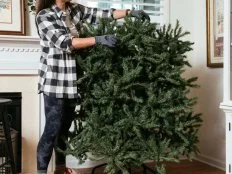
Situate the Christmas tree stand on the ground and place the tree securely at the bottom of the base. Turn the screws on the base enough so the tree is lightly held between them, but not to the point where they're penetrating the bark.
First, you have to make sure the tree isn't crooked.
Something to keep in mind for this step: trees come from nature and nature is chaotic. Odds are your tree won't be perfectly symmetrical. The best way to mask the imbalance is by having the top branch (where the star or angel goes) perpendicular to the floor from all angles. Even if one side of the tree appears bulkier while wrapped (your tree should still be in the red netting), you'd rather have uneven pine distribution than a crooked tree.
Once you've found the perfect angle, hold the tree in place while someone tightens the screws so it's able to stand at that angle alone (no need to tighten past that). Now it's time to cut the netting off and wait a few hours for the branches to settle before decorating.
The Best Place to Put a Live Christmas Tree
There are a few things to consider when it comes to deciding where to place your tree in your home this Christmas
Heat and Sunlight: The key mistake one can make when finding their tree’s home, is excessive exposure to heat and sunlight. Your tree shouldn’t be anywhere near a radiator or (if possible) sunlight.
Ornaments: Once those spots have been ruled out, consider how many ornaments you have. It’s easy to amass an overwhelming collection of decorations over the course of a few years. If you want to show them off, place the tree in a central location, away from any walls that would obstruct the view of a given side.
Glare Risk: Think about any glare that would end up on a television screen if the tree’s lights are in the reflection.
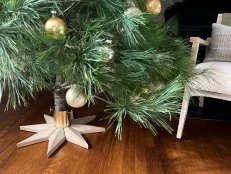
Floor Type: Remember that the tree stand should be full of water at all times, so if moisture is the enemy of your floors, don’t invite that kind of stress going into the holidays — or put down a towel or mat under your tree stand to prevent water damage.
How to Maintain a Live Christmas Tree
When asked for tips on tree maintenance, Scott had a simple answer: “It’s just a big flower.” In other terms, keep the tree stand full of water at all times. Establish a habit of checking the water at the end of each day. The water level should rise to roughly one inch below the brim of the tree stand (or higher if you like to live dangerously). It's truly impossible to overwater a Christmas tree. If you’re buying a pre-cut tree, make sure that any hardened coating of sap (the dried amber substance at the base) is severed when chopping off those final branches.
Unless you’ve chopped down the tree yourself, there’s no way to know how long it’ll maintain its vibrant colors and powerful aroma. A healthy fir can thrive for over a month after being harvested, but a white spruce may only get a couple weeks. If you are buying it pre-cut, ask your friends and family to see which vendors they’ve had the best experiences with. You don’t want to spend Christmas morning dusting dead pines off each gift.
Why You Should Trust Our Expert
Scott Edwards is the eighth generation owner of Maple Row Farm in Easton, Connecticut. Christmas is year-round for Scott, as every day is dedicated to maintaining the standards for the next Christmas season and beyond. His life has been spent tending to Maple Row Farm, which becomes abundantly clear every time he beams with pride as he gazes across his family’s legacy. Not everyone is lucky enough to be driving distance from a place like Maple Row farm. If you are, this is your call to action to chop down your own tree this year. And if you can’t, it’s no big deal: every Christmas tree is magical. Every single one.













.jpg.rend.hgtvcom.231.174.85.suffix/1738869872256.webp)