





.jpg.rend.hgtvcom.196.196.suffix/1738869872256.jpeg)


How Do Pneumatic Tools Work?
Pneumatic tools are powerful and efficient, making them a great choice for nearly any job, but they’re not quite like your electric tools. Here’s what you need to know about how pneumatic tools work and what it takes to keep them going.
Karen Kavett

Air Pressure and Air Volume
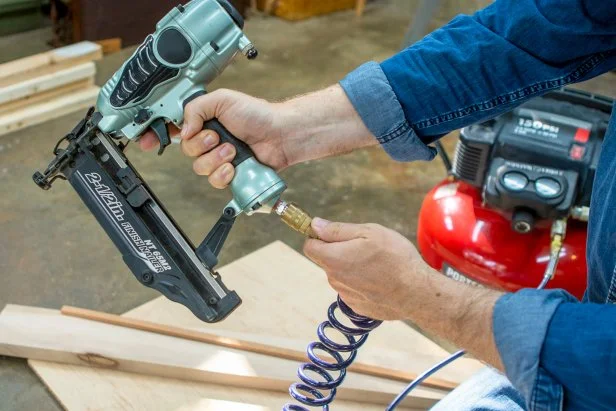
Pneumatic tools are powered by air that’s typically delivered from an air compressor. The air is sent through a pressure regulator that’s set to the required pressure for operation of a given tool. The air leaves the regulator through a hose that’s mounted to the tool via a ¼” quick release coupler.
Once the air enters the tool, it’s fed through a pneumatic motor that converts the compressed air’s energy into mechanical work. Linear-action tools like hammers and nail guns typically employ a piston-style actuator, while rotary-action tools use a geared or turbine-style motor. Pulling the trigger on the tool sends the air into the motor and causes the tool to begin work.
Air Requirements and Duty Cycle
Every air tool can run continuously as long as it can be constantly supplied with the volume of air it demands at the correct pressure. For tools like paint sprayers, which require large volumes of air at lower pressures, it’s advantageous to have a compressor with a larger tank. Every time you pull the trigger on a paint sprayer, it releases a large volume of air compared to something like a nail gun or impact hammer. Nail guns typically use short bursts of high-pressure air to drive nails. So while a nail gun doesn’t require a large volume of air, it definitely demands a higher pressure to deliver the force needed to penetrate materials.
The balance between pressure and volume has an effect on how hard your air compressor has to run in order to keep up with your work. A small pancake-style compressor is fine for most nail guns and other short-duration tools, but its small tank can’t hold enough air to properly operate a something like a spray gun. Spray guns and sanders that need large, continuous volumes of low-pressure air require compressors with much larger tanks. Larger tanks increase weight, which reduces portability. Additionally, larger volume compressor tanks often require higher horsepower motors to rapidly fill and pressurize their tanks. Depending on the style of motor, this can be a big contributor toward noise from your air compressor.
Clean and Dry Air Along With a Little Care
Since pneumatic tools depend on air for their operation, they’re susceptible to the moisture that’s inherently present in the air in the form of humidity. As your compressor ingests air and compresses it, water vapor will condensate inside the tank and can cause rust and corrosion. Additionally, moisture can be delivered to the tool and cause premature wear along with rust. Many people choose to add a small air/water separator between the tool and compressor to prevent water from being delivered to the tool. However, you can avoid moisture damage by routinely draining your compressor’s tank and periodically lubricating your tools. Make sure that you only use oil specifically designed for pneumatic tools. Using the wrong oil can cause damage to your tools, your compressor and can be ejected from the tool causing damage to your project.
Always take care to inspect the condition of your air compressor. If your tank appears to have rusty spots or weak metal areas, it’s a sign that something is wrong. Neglected air compressor tanks should NEVER be pressurized.







.jpg.rend.hgtvcom.231.174.85.suffix/1738869872256.webp)








.jpg.rend.hgtvcom.231.174.85.suffix/1738869389274.webp)

