

What to Know About the House Centipede
Put that swatter down! The reclusive house centipede may be the poster child of a creepy-crawly, but it’s harmless and working for you for free.


Shutterstock/Ivan Marjanovic
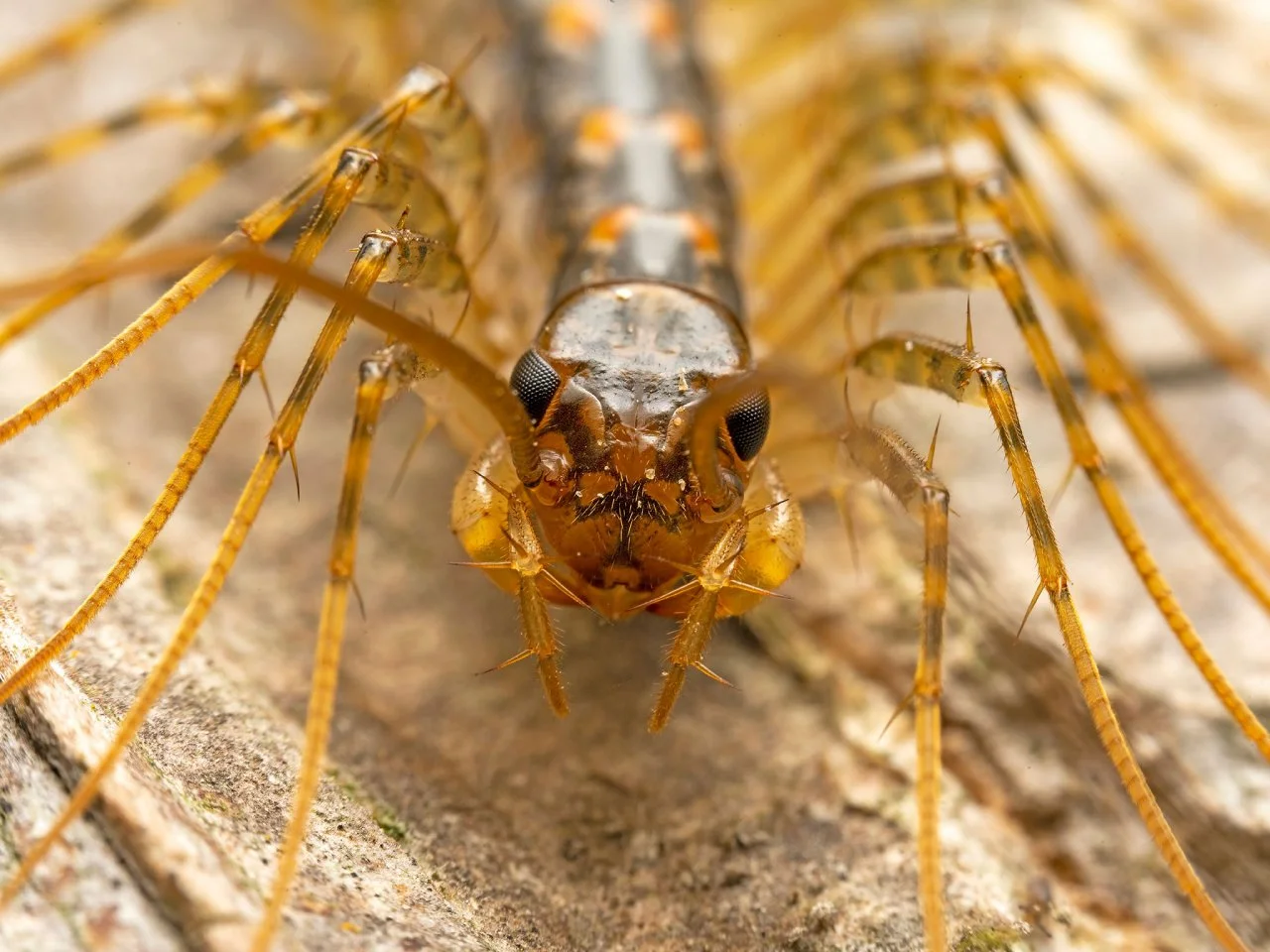
So many legs, so many options: A house centipede contemplates where to dart next. The adult house centipede has 15 pairs of spindly legs that ripple as it runs. Immature house centipedes start with four pairs and gain legs over five molts.
What Are House Centipedes?
The harmless house centipede, Scutigera coleoptrata, is a spindly, scurrying bug likely hiding in your bathroom or basement. Though totally benign — even beneficial — this reclusive and solitary creature is undisputedly the poster child of a creepy-crawly.
How to Identify a House Centipede
The house centipede has a yellowish-tan body, with three dark stripes running its roughly 1-inch length. Dark bands encircle 15 pairs of sprawling legs. At the head, even longer antennae flitter over a pair of venomous pincers called forcipules that used to be legs. The rear legs work in a sensory role too and are nearly antenna length in the female. This gives the centipede a two-headed appearance and brings the whole unnerving package closer to 4 inches long. The nocturnal house centipede can dash so quickly on its appendages that it looks more like 50 pairs than 15 to the surprised human who has done nothing more offensive than turn on a light. Fun fact: Centipede species vary in number of legs but it’s never exactly 100, because they always have an odd number of pairs (NPS).
Other Bugs that Look Like House Centipedes
No matter where you live in the country, you’re enjoying the company of multiple species of centipede, which may include bark centipedes, stone centipedes and soil centipedes. Those other species might wander into your home, but the house centipede is the only one happy to move in. The house centipede’s curvy physique and supermodel legs distinguish it from its centipede cousins, who sport sleek, more uniform bodies and shorter legs. If what you’re glimpsing is shockingly fast, it’s likely a house centipede. The creature is also the only centipede species with compound eyes.
Usually, what we mistake for house centipedes inside aren’t centipedes at all. Millipedes have a rounded body with two pairs of short legs per body segment, instead of the centipede’s one pair per segment. A millipede will curl up when surprised, rather than do the house centipede dash. Silverfish, firebrats and earwigs are insects that share an approximate body size with the house centipede, but the similarities end there.
- Silverfish are gray or blue with only three pairs of relatively short legs. They look like little Napoleans, with their oversized chests and narrow hips, and they wiggle like a fish when they move, hence the name.
- Firebrats look a little like a brown silverfish but without the prison build, and you’re more likely to find them in the kitchen or HVAC closet than the bathroom because they crave the cozy.
- Earwigs are generally brownish-red, with three pairs of grasshopper-like legs. The recognizable trait of an earwig is a pair of curved pincers on its rear. Nobody else has a posterior that perilous.
Of these critters, the silverfish and firebrat are destructive. They’ll dine on your gorgeous wallpaper, your favorite novel and your breakfast cereal.

A silverfish relaxes with a book over dinner. Silverfish are sometimes mistaken for house centipedes, but they aren’t even in the same class, literally. Silverfish are in the class Insecta instead of the house centipede’s Chilopoda. In case it’s been a few years since you nodded off in biology, everybody creeping around your house with an exoskeleton is in the phylum (bigger than a class) Arthropoda. So, if you aren’t sure about a bug, hedge your bets and call it an arthropod. In any case, silverfish are legitimate pests that will make meals of your starchy food and cellulose-containing possessions, like books. Luckily, house centipedes make meals of silverfish!
Habitat and Distribution of House Centipedes
The house centipede might as well be called the bathroom centipede because dashing across the bathroom floor or darting along a shower wall is where we commonly encounter the creature; but kitchens, basements and crawlspaces will all do for house centipede digs. Inside, the house centipede is hiding in a crack or crevice in a humid area of the house. Outside, it’s hanging out in a damp wood pile or under leaf litter. As you may have noticed, the preferred environment of a house centipede is somewhere secluded, dark and moist.
House centipedes are found across the US — and all over the world. In colder regions they might spend their entire lives inside our homes. In more seasonal climates, the house centipede may live in the yard when it’s mild and come inside when the weather gets cooler.
Why Are Centipedes In My House?
The house centipede may be reclusive, but it isn’t mysterious. Its tastes are simple: a moist area with a food source. In this respect, its presence can serve as the canary in the coal mine. According to PennState Extension, if you spot several house centipedes in short order, you should be concerned about a resident population of one of the household pests they feed on. Similarly, if you see a house centipede in a closet or a living area that should be dry, you might check for a plumbing or roof leak.

Shutterstock/Miro Skandera
Legs vs. legs: A house centipede has a spider-ous lunch. House centipedes hunt and eat nearly all our pests, making the centipedes contributing members of the household. House centipedes use a variety of techniques to subdue prey that make use of their speed and agility, poisonous pinchers and barbed, multijointed legs just made for wrangling.
Benefits of House Centipedes
The poor house centipede gets lumped in with those unsavory characters as a household enemy and target of eradication, but unjustly so! Unlike a bedbug or furniture beetle, you won’t find the humble house centipede chewing on you or your sofa because the house centipede isn’t interested in you or your stuff at all. What the house centipede is interested in is making a meal of those very household pests ruining your groove!
And the house centipede is a little mixed martial artist, choosing a hunting technique based on the prey. The swift injection of toxins from its forcipules will subdue aggressive prey like a wasp while the house centipede retreats to a safe distance. Its multi-segmented barbed legs will lasso and wrangle a cricket. Speed and agility make the house centipede a fabulous ambush predator of roaches and other quick movers. House centipedes actually pounce on prey. Writing in the Journal of the Kentucky Academy of Science, Charles A. Acosta explains these adept hunters can capture several meals at once, feeding on one while detaining the others for later courses.
After they eat, they clean up, which is frankly kind of cute. House centipedes are fastidious groomers, with specialized organs they pass their antennae and legs through. One at a time, in order. One side, then the other. You can witness this and more in PBS’s Deep Look episode on the critters.
What Do House Centipedes Eat?
The menu for a house centipede is essentially a most-wanted list of property-damaging arthropods including carpet beetles, moths, silverfish, firebrats — and the psychologically damaging ones too like bedbugs and cockroaches. Because house centipedes dine on the larvae and youngsters of many of these bugs, they can prevent a few troublesome trespassers from ever becoming an expensive infestation. House centipedes even make meals of disease-spreading ticks, fleas and flies.

Shutterstock/chinahbzyg
Is that you, Frankie? Unlike many arthropods, house centipedes develop slowly, taking close to three years to fully mature. They can live as long as seven years, so you may as well give a name to the one you saw this morning.
How to Manage House Centipedes
As a little exterminator of legitimately harmful bugs, the house centipede should be viewed as your private bouncer or tiny rent-paying roommate. It’s really the ideal model of the latter because, unlike many roommates, the house centipede is always at work, won’t mess with your stuff and doesn’t leave its stuff all over the place. Seriously, this bug leaves no evidence of its presence the way roaches and crickets do. For the record, the house centipede is capable of stinging, but that’s going to be the result of a misunderstanding — say, an attempted bare-hand capture or an ill-placed foot. The pain of the sting is equivalent to that of a bee and poses a problem only for the highly allergic. Young centipedes can't even break through human skin. Bottom line: Don’t dismiss! Coexist!
That said, if your home is getting crowded or you just can’t deal, you may need to take some house centipede control measures. This involves three activities on your part: preventing access, controlling moisture and removing food sources.
- Physical prevention: Identify and seal cracks in foundation walls and caulk around doors and windows. Ensure that your sump pump cover is sealed. Contrary to popular belief, house centipedes are not coming up through the bathroom plumbing.
- Chemical prevention: Many pest control websites mention that certain essential oils — peppermint and tea tree, for example — can be effective as natural repellents at typical centipede entry points. Note: Pet households should avoid this approach as most of these oils are toxic to cats, dogs and birds.
- Moisture control: Create a debris-free perimeter around your home about three feet wide. Debris is defined as anything that holds moisture near your foundation — wood, leaf litter, grass clippings and even small gravel. Inside, provide ventilation to crawl spaces and eliminate standing water and sources of moisture in the basement, running a dehumidifier if necessary.
- Food source elimination: Detect and eradicate the aforementioned insect populations that serve as meals for the centipedes.
How do I remove a house centipede in my house?
Usually, the house centipede you shrieked at is already under the baseboard before you can do anything about it. But if one falls into your bathtub and gets stuck — it happens — and you don’t want its continued residence, do not kill it. Relocate that useful fella to the yard, where it will do the same job managing pests at a more comfortable distance. An empty jar to transport it is a better solution than your hand because it does have a business end, remember.
Also, if you make your home inhospitable in terms of moisture and food, the house centipede will move out on its own.
When should I call a professional about house centipedes?
You shouldn’t bother calling an exterminator if you see a house centipede every now and then. House centipedes are solitary critters, and you don’t have to worry about an infestation unless your definition of infestation is in the single digits. That said, if you are spotting them regularly, it’s actually worth an inspection. This is less about the centipedes and more about the potential infestation of a destructive critter that the house centipedes are indicating by their presence. While crawling around with the flashlight in all your home’s nooks and crannies, the pest-control expert can uncover plumbing leaks too.

9 Everyday Items That Can Help Control Household Pests
Annoyed by ants, gnats, cockroaches or other pests? (Shudder.) Here's how to vanquish them with common ingredients you likely have on hand.