






What Is a Boneless Couch? The Internet’s Couch-in-a-Bag Trend, Explained
Before you buy into the boneless couch trend, here’s what experts say to know about comfort, support and durability.


ExperienceInteriors
If you browse sofa options online for long enough, and you’ll notice a certain kind of couch has started to appear again and again: low-slung, modular, cloud-like and often half the price of a traditional sofa or sectional. In photos, many look like the cozy, oversized couches that have become popular across social media. The surprise comes later, when the couch arrives compressed in a vacuum-sealed bag with instructions to let it expand into shape over the next day or two.
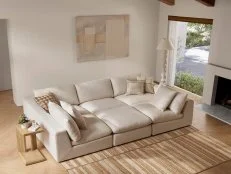
These are the sofas dubbed by the internet as “boneless couches”: low-profile, frameless and made almost entirely of foam or soft fill instead of a traditional wood or metal frame. They promise a relaxed, lounge-friendly feel at a more accessible price point, but they also raise a fair question: Can a couch that comes in a bag really replace a traditional sofa? We asked interior designers, a chiropractor and retailers what shoppers should know before buying into the trend.
What Is a Boneless Couch?
A boneless couch is generally a low-profile sofa without the structured frame, springs and separate cushions found in many traditional sofas. Instead, they are constructed primarily with foam or soft fill. The result is a softer, more relaxed piece of furniture that is designed more for lounging than formal sitting. Also, due to their lack of "bones," they can easily be vacuum-sealed for lightweight, compact shipping. They arrive in plastic bags that often arrive in one box and expand to reach their full size, to the delight of many Instagram users.
“Boneless couches have a distinctly relaxed, casual aesthetic,” said Aly Morford, co-founder and principal designer of Pure Salt. “They prioritize softness and comfort over structure, and while they can be incredibly comfortable for lounging, reading or watching a movie, that same softness isn't always ideal for everyday seating.”
That is the biggest thing to understand before buying one. A boneless couch is not necessarily trying to be a traditional sofa. It offers a different kind of experience, one that may feel cozy and casual for short-term lounging but still less structured and supportive than what many people expect from a standard couch.
Why Are Boneless Couches So Popular Right Now?
Part of the appeal is easy to understand. They are affordable, easy to ship, and require no assembly. Boneless couches fit into the larger shift away from formal living rooms and toward softer, more relaxed spaces made for lounging, watching TV and everyday comfort.
“People are prioritizing comfort and casual living more than ever,” said Stephanie Mazzei, senior commercial designer at Wayfair. “These sofas are designed for lounging, movie nights and everyday relaxation rather than formal entertaining.”
Mazzei also says there has been growing interest in low-profile and frameless sofas as shoppers look for furniture that feels comfortable, versatile and easy to live with. Their clean lines, oversized cushions and minimalist look can work especially well in contemporary and Scandinavian-inspired spaces.
Leigh Lincoln, co-founder and principal designer of Pure Salt, noted social media has also played a role in shaping what shoppers want. “What’s trending always has bearing on consumer preference,” she said. “As seen on social media, the influence of price point, comfort and delivery speed is strong. It’s a low-level investment for an immediate payoff.”
Where Boneless Couches Work Best
Designers are most enthusiastic about boneless couches when they are used in casual spaces.
“Boneless couches work best in spaces designed around relaxation rather than formal entertaining,” Lincoln said. “They're a natural fit for media rooms, family rooms, vacation homes, teen hangouts or casual loft spaces where comfort is the primary goal.”
Michelle Gage, creative director of Michelle Gage Interiors, is more skeptical of the trend overall. She would not recommend boneless couches to clients and thinks they are suited only for low-use spaces, like a kids’ playroom or basement.
Mazzei takes a slightly more flexible view. She says boneless couches can work as an alternative to a traditional sofa, depending on the look you are trying to achieve.
“They create a more relaxed, lived-in feel rather than a formal look,” she said.
Are Boneless Couches Actually Comfortable?
Boneless couches can be comfortable, but comfort is not the same as support. If you plan to use one as your main sofa, it’s important to consider if a boneless couch offers the support you need.
Dr. Bobby Bilitsis, chiropractor and co-founder of Prestige Health and Wellness, says a low-profile, frameless couch is not automatically bad for your spine, but its support may be less predictable than that of a framed sofa.
Its comfort and support depend on several factors, including the firmness of the foam, how resilient it is, how the couch is constructed and the height and shape of the backrest. A well-designed couch with appropriately firm foam may feel comfortable while still offering support. But if the foam is too soft or compresses too much, the body can sink into a slouched position.
“A boneless couch may feel comfortable for short-term lounging, but comfort during the first ten minutes is not necessarily the same as support over several hours,” Bilitsis said.
He also said shoppers should pay attention to seat height and depth. Ideally, your feet should be able to rest firmly on the floor, your hips should be level with or slightly higher than your knees and you should be able to sit against the backrest without losing support. If the seat is low, which is characteristic of many boneless couches, it can encourage the lower back to round or make it harder to sit comfortably for long periods.
Do Boneless Couches Hold Up Over Time?
The longevity of these couches was a big concern among designers. Because boneless couches rely on foam or soft fill instead of a structured frame, they require more maintenance to keep their shape and eventually will lose shape with use.
“In general, boneless couches require more upkeep to maintain their appearance,” Lincoln said.
Gage has similar concerns. Since many boneless couches are essentially made from foam, expect them to lose their shape and wear out faster than a traditionally constructed sofa, she said.
Shop This Look


What to Know Before Buying a Boneless Couch Online
The biggest question is how you plan to use it. If it will be your main sofa, think about who will sit on it every day and whether it will be comfortable for everyone in your home.
“If this will be your primary sofa, consider whether everyone in your household, including children, older adults or guests, will find it easy to get in and out of,” Morford said.
That is especially important because many boneless couches sit low to the ground. Bilitsis said lower seating can require more effort from the knees, hips, legs and trunk when sitting down or standing up. This may be more difficult for people with knee or hip pain, lower-back discomfort, reduced leg strength, limited mobility or balance concerns.
Shoppers should also look at the construction details. Morford recommends paying attention to the quality of the fill, how the cushion is constructed, whether the cover is removable and washable and how much maintenance the sofa requires to keep its shape.
Mazzei recommends reading verified reviews and looking for customer photos or videos, especially ones that show how the sofa looks after it has been used for a while. That can give shoppers a more realistic sense of comfort, quality and durability than a product photo alone.
Before buying, check the return policy, dimensions, seat height, cover material and care instructions. And if the couch arrives compressed, give it the full amount of time recommended by the manufacturer to expand before judging its shape and support.
So, Should You Buy a Boneless Couch?
A boneless couch can be a good choice if you want casual seating for a media room, playroom, basement, teen space, apartment or relaxed lounge area. It can also work if your home leans more informal and you like the look of low-profile, cloud-like furniture.
But experts do not all see boneless couches as a true one-to-one replacement for a traditional sofa.
“I see them as a complementary option rather than a complete replacement,” Morford says. “They fill a different role in the home... For households looking for versatility, long-term durability, ergonomic support and a timeless aesthetic, a traditional sofa remains the more practical option.”
Gage is more direct: “I don't. The comfort, longevity and quality simply aren’t there.”
That does not mean all boneless couches are bad. It means they come with trade-offs.
To be clear, a boneless couch is not the sofa you buy with the hope of keeping it for the next 30 years. A boneless couch is not pretending to be heirloom furniture—but for some, that may be the point.
For those who are renting, moving cities, furnishing a first apartment or still figuring out what they want their home to look like, a lower-commitment sofa can feel more realistic than investing in a traditional piece you hope to keep for decades. They meet a real need for those who want comfort, flexibility and a couch that works for this version of their life, even if it is not the last sofa they ever buy.




.jpg.rend.hgtvcom.231.174.85.suffix/1739987866538.webp "RX_HGTV_BurrowReview_OpenerTestedSeal - 1")


.jpg.rend.hgtvcom.231.174.85.suffix/1738869872256.webp)


