

Use Fall Leaves for Winter Mulch
Do yourself, your garden and your community a favor this fall. Reuse those leaves!

wholden
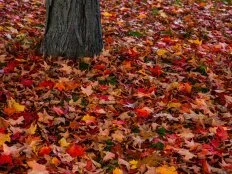
Fall leaves are a great source for winter mulch.

Temperatures are dropping and so are leaves. This fall when you remove leaves from your lawn, save them to reuse in other areas of your yard. Reusing fall leaves as mulch is one of the most natural things a gardener can do. It benefits plants, reduces landfill waste and best of all, it’s free!
Collecting
Normally, when lots of raking is employed to collect fallen leaves, you are left with giant piles of leaves, sticks and other debris. The material is useful at this stage, but not really in a user-friendly format. There are a few other methods of collecting fall leaves that will save time and space. One option is to use the mower. A bagging mower is an obvious choice to suck up the leaves and dump them in a pile until needed. If you own a side-discharge model simply mow in concentric circles, keeping the discharge chute pointed toward the center of the circle. Another option is to use a leaf blower with a shredder/vac attachment.
Spreading
The handy thing about fall leaf mulch is that it is lightweight and immediately ready to use. If the leaves have been well chopped, they can be used to topdress perennial, shrubs, trees or late season vegetable gardens. Simply spread the material over the beds at a 2- or 3-inch depth. Unchopped leaves are useful in natural areas, but be careful not to let them pile up too deeply over desirable plants. Because leaves decay very slowly (up to a year or more in some instances), deep layers of leaves, 6 inches or more, must be removed from plants at the beginning of the growing season in order for the soil to get warm, dry out and to allow the plants beneath to get to the sunlight. On the other hand, if you have a weedy area that you want to get under control, cover it with a layer of cardboard and pile the leaves on top to kill them off.
Avoid These Species
Black walnut and eucalyptus leaves contain compounds that are harmful to other plants. Avoid using their leaves anywhere other than around themselves.
What Else
Fall leaves are useful in three forms: leaf mulch, leaf mold and leaf compost. To a large extent they are interchangeable, but there are subtle differences in makeup and “ideal” usage. Leaf mulch, which has just been described, takes advantage of the immediate action of decomposition of fall leaves. Early collection (soon after the leaves fall) and shredding will help to maximize the micro-nutrient benefit to the plants receiving this mulch application. Traces of calcium, magnesium, phosphorous and potassium are made available through leaching as the leaves biodegrade, and the dried remains continue to protect the soil surface and insulate the root zone.
Leaf mold is made by piling leaves, which have a high carbon content, without adding a source nitrogen (as would be done to make compost). Fungi are the primary microorganisms breaking down leaves in this setting, producing a material that is useful for improving soil texture as well as kick-starting the soil microbe ecosystem. Leaf compost is made using the “traditional” composting method of mixing high carbon-content ingredients, like fallen leaves, with high nitrogen-content ingredients like grass clippings, fresh manure or kitchen scraps. Compost makes the most effective use of the limited nutrient content of fall leaves.