Cicadas 2025: Everything You Need to Know
One of the largest periodical cicada broods — Brood XIV — is emerging in 13 states in 2025. Learn about these fascinating creatures and discover a few practical considerations for your home, garden and pets.

Cicadas have never needed a PR department. They don’t do any of the typical icky insect pastimes like biting, stinging, darting or creeping. They don’t eat our precious plants. And they’ve provided the soundtrack of summer for many of us. As far as bugs go, public sentiment is remarkably positive. That said, when thousands of insects appear in one’s yard, it is possible to be fascinated and a little disconcerted in equal measure. Learning about these creatures will tip those emotions in favor of fascination.
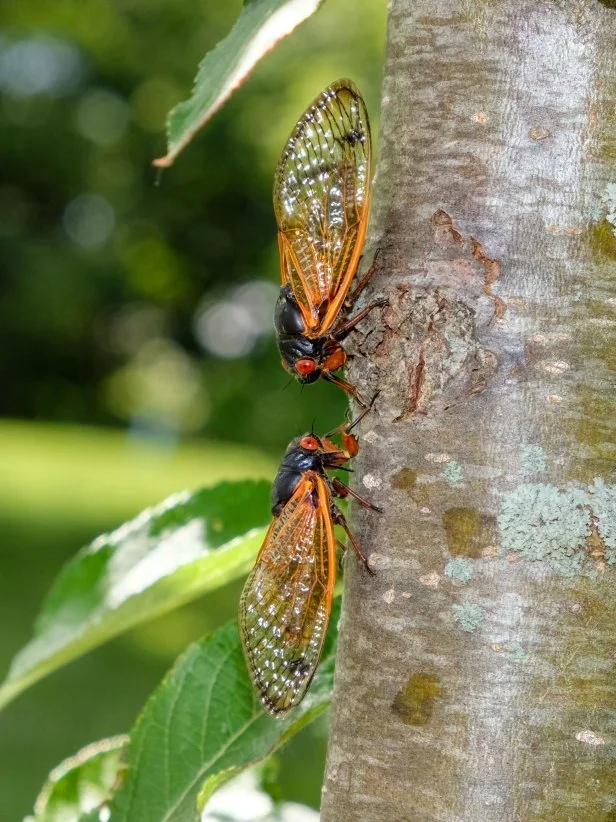
Gene Kritsky, Mount St. Joseph University
Two periodical cicadas sizing each other up before mating.
Why the Interest In Cicadas This Year?
Cicadas are intriguing because most of their lives are spent literally under our radar, as nymphs underground. We’re only aware of them when they climb out of the soil (the emerging part) for a month or so to mate and lay eggs, then poof — they're gone. Every state in the continental US has annual cicadas (also known as dog-day cicadas) that we see every year because they have life cycles of two to five years that are unsynchronized, meaning some are up while others are down.
But you may not realize that there’s this whole other type of cicada called periodical cicadas with very long life cycles, 13 or 17 years depending on the species. Like their annual cousins, all but a month or so of this time is spent in the soil under a favorite tree. Aside from the crazy length of time they’re underground, periodical cicadas are special because their long life cycles are synchronized, meaning when they finally emerge after more than a decade, they all do it together. Scientists think part of the reason for this is predator avoidance: With that many cicadas all at once, some are able to survive and reproduce even if a bunch are eaten before the opportunity. Regardless of the why, it creates quite the spectacle, quite a racket and it’s happening this year!
In This Article
- Which Periodical Cicadas Are Emerging In 2025?
- Where Will the Periodical Cicadas Emerge In 2025?
- I’m in That State! Will I Get to Witness the 2025 Emergence?
- When Will the Periodical Cicadas Emerge?
- Why Do Cicadas Make So Much Noise?
- When Will the Periodical Cicadas Be Gone?
- Will Cicadas Harm My Trees and Plants?
- Which Plants Should I Be Concerned About?
- How Can I Protect Delicate Trees From Periodical Cicadas?
- Will Eating Cicadas Harm My Pet?
- Will So Many Cicadas Damage My House?
- What Are the Benefits of Cicadas?
Which Periodical Cicadas Are Emerging In 2025?
Scientists call a group of periodical cicadas on the same schedule in the same region a brood. This year, Brood XIV is emerging in the US, composed of the three 17-year species of periodical cicada: Magicicada septendecim, Magicicada cassini and Magicicada septendecula. The last time Brood XIV emerged was 2008.
Where Will the Periodical Cicadas Emerge In 2025?
Brood XIV is the second largest brood of periodical cicadas in terms of geography, with a territory across a wide swath of the Eastern US. They’re anticipated on New York’s Long Island; in the city of Cincinnati; and in the scenic valley of Cades Cove in Tennessee’s Great Smoky Mountains. According to enthusiast website Cicada Mania, 13 states can expect Brood XIV: Georgia, Indiana, Kentucky, Massachusetts, Maryland, New Jersey, New York, North Carolina, Ohio, Pennsylvania, Tennessee, Virginia and West Virginia.

Gene Kritsky, Mount St. Joseph University
Periodical cicadas, which spend the vast majority of their 13-year or 17-year lives (depending on the species) as nymphs underground, emerge in large numbers at the same time as part of a synchronized life cycle.
I’m in That State! Will I Get to Witness the 2025 Emergence?
Do you remember seeing them in 2008? Even then, it’s hard to know for certain. Some neighborhoods that met Brood XIV before could see them this year, and others may not. It all depends on precisely where the locals went into the soil 17 years ago and how life has gone for the nymphs since then.
Before last year’s double-emergence, we reached out to entomologist Gene Kritsky, Professor Emeritus of Biology at Mount St. Joseph University, to fill in the blanks on some of the finer points of cicada activity, and the overlap with human activity. As Kritsky expected, 2024’s dual emergence was not larger in the numbers of cicadas in specific locations but was very large geographically. Similarly, he anticipates that this year there will be some locations with large numbers of cicadas, but there will also be widely scattered pockets of cicadas. “The numbers of Brood XIV have been dwindling over the past two centuries,” he says. “Land use and deforestation has contributed to the decrease.”
In fact, some of Brood XIV’s 2008 territory was hit by Hurricane Helene. Kritsky says the impact of hurricanes has not been studied, but anything that destroys trees will impact cicadas. “I do have a study site where trees were removed and replaced after the 2008 emergence,” he says, “and I am watching to document what the removal means for the cicada emergence.”
Like last year’s two broods, Dr. Kritsky is tracking Brood XIV through Cicada Safari, a periodical cicada mapping app he developed that allows users to find local sightings and report their own. As soon as reports are verified, they go live on the map. So, you can use Cicada Safari to check your immediate area for recent Brood XIV activity.
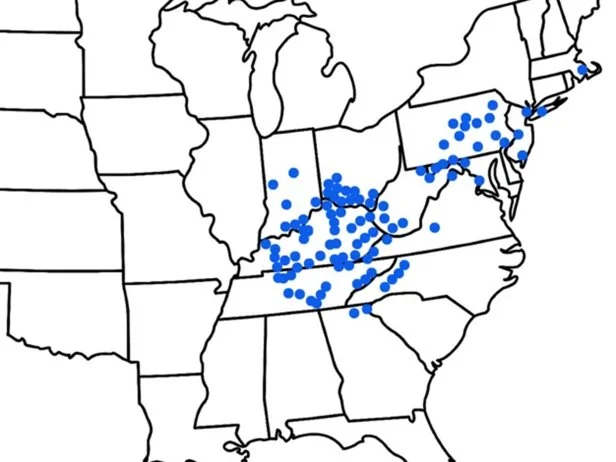
Gene Kritsky, Mount St. Joseph University
In 2025, Brood XIV is expected in 13 states across the Eastern half of the US.
When Will the Periodical Cicadas Emerge?
Periodical cicadas start emerging when the soil is warm — a comfy 64-degree ground temperature, to be specific — so that can happen in late April in Southern states, then later into May as you move northward. If you’re looking for advance notice, Kritsky says a spring downpour might oblige. “In mid-April, cicada nymphs will sometimes make mud chimneys after a heavy rain. This is often two weeks before the emergence starts,” he explains.
Why Do Cicadas Make So Much Noise?
When a nymph emerges from the soil, it loiters on a tree or fencepost for a few days in order to shed its childish skin and for its adult skin and wings to be ready for action. Then, it flies into the tree canopy as an adult cicada and promptly begins making a racket. The cacophony we hear is referred to as chorusing, it’s the males doing it and it is ALL about reproduction. Male cicadas have a pair of abdominal membranes called tymbals they use to sing, and a hollow abdomen amplifies their songs. The female cicadas answer with a subtle (by comparison) clicking sound, produced by flicking their wings. Each cicada species has a different sound.

Gene Kritsky, Mount St. Joseph University
An adult periodical cicada from Brood XIV after molting but before its exoskeleton has hardened.
When Will the Periodical Cicadas Be Gone?
If adult periodical cicadas can avoid being eaten during this intense mating period, they will live for about a month. The eggs that the females lay during that time will hatch after 6 to 7 weeks, at which point the nymphs drop out of the nest and burrow underground. This part is much quieter.
How Will I Recognize the Periodical Cicadas?
The calendar is one indicator. Periodical cicadas have an earlier schedule than most annual cicadas, and the periodical adults are frequently gone from an area before its annuals emerge. Where Kritsky hails from in the Midwest, the periodical cicadas may be finished by the end of June. Then, the annual cicadas usually start emerging at the beginning of July, sticking around until the end of September.
Visually the two groups of cicadas are often easy to distinguish. If you’re looking at a green cicada, it’s an annual cicada because all periodical cicadas are black with red eyes. If your area has annual cicadas that are also black, look closer. “The various species of dog-day, or annual, cicadas are larger than their periodical cousins and have black or greenish eyes,” Kritsky explains. “Their heads are wide and flattened, not slightly rounded as in the periodical cicadas.”

Gene Kritsky, Mount St. Joseph University
All seven species of periodical cicadas are black with orange wing veins and red eyes. The striking blue eyes on this unique creature were accompanied by lightly colored wing veins. They are likely caused by a dilution gene, seen in other species too, like horses. It's very rare with cicadas and this Chicago cicada from the 2024 emergence is the first Dr. Kritsky has personally encountered in his 50 years of mapping cicadas.
Will Cicadas Harm My Trees and Plants?
Not by eating. Both as adults and as nymphs underground, cicadas will suck on your trees and woody plants, but they don’t harm plants by feeding. In fact, cicadas do not have mouth parts to chew, so if something’s munching on your tomatoes, don’t blame the cicadas.
What can do some temporary damage to small tree branches is periodical cicada nesting activity, especially during large emergences. The twig the nests are laid in will sometimes flag, meaning the twig mostly breaks and the leaves die. Kritsky explains the nesting process in his book on the 2024 double-emergence, A Tale of Two Broods. After mating, the female cicada creates a little slice in a tree twig in which to deposit 10 to 20 eggs. She moves up the branch and repeats the process until she’s laid all her eggs, around 500 in number.
The female cicada prefers new growth near the end of the branch for her nests, which is why trees get that seared look when the twigs flag. “It is unsightly,” says Kritsky, “but the best thing to do is to let nature take its course since the flagging is not long term. The trees will recover next year.”
Which Plants Should I Be Concerned About?
Woody plants and trees with small-diameter limbs are the ones that female periodical cicadas will be interested in. But it’s only the young or small woody plants and trees with a few branches that are vulnerable. Mature trees and shrubs are hardy enough to withstand flagging, so it’s not an issue for established vegetation. Also, because cicadas only care about woody growth, they are not interested in your flowers or your vegetables.
It should be some comfort that you and the female periodical cicada share an interest in the tree’s enduring health. If a twig flags, up to 50% of the eggs laid in it won’t hatch. Kritsky explains in his book that the choice of a tree is a critical one for the female. “She must find a tree that will live for at least 17 or 13 years to ensure that the developing young will have tree roots on which to feed. If the tree should die or be cut down, the young cicadas will perish,” he writes. Favorites? Trees in full sunlight with low vegetation surrounding them.
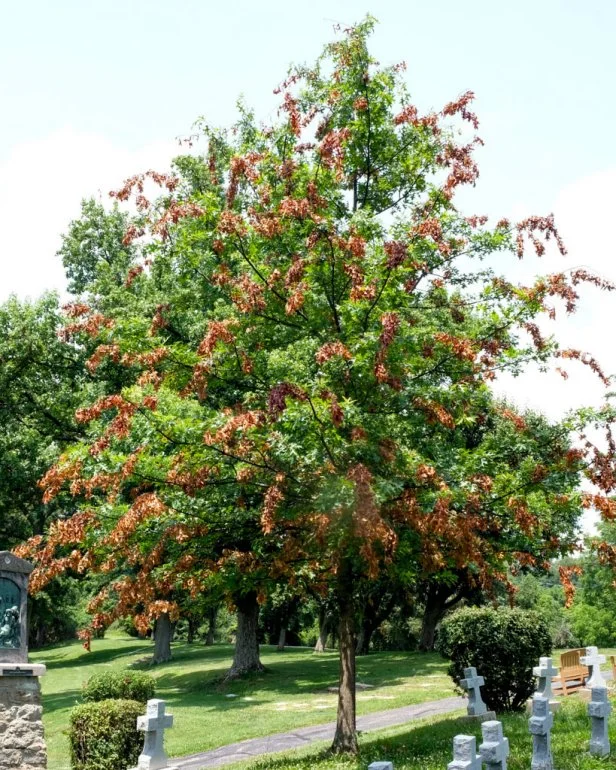
Gene Kritsky, Mount St. Joseph University
The creation of eggnests in small-diameter branches by female cicadas can cause flagging, in which the twigs mostly break and the leaves die. This natural pruning won’t harm mature trees and is thought to result in greater blossom and fruit production in the year following an emergence.
How Can I Protect Delicate Trees From Periodical Cicadas?
If there are young woody plants and trees in the yard, Kritsky advises us to cover them with cheesecloth or netting to discourage females from laying eggs. He says to focus on the small stuff which, in some cases, can include your azaleas and rhododendrons. “They will lay eggs in woody shrubs, especially if the emergence is large and there is competition for suitable branches,” he adds.
Kritsky says you can wait to apply the netting until right after the first cicadas emerge because it takes five days for cicadas to even begin mating. Then, because staying netted isn’t good for trees, don’t forget to take netting off at the first opportunity. “The nets can be removed when the cicadas' singing is not sustained in loud chorusing,” he advises, adding that isolated single calls are okay because it signals to us that there are not many adult cicadas left to lay eggs.
For new purchases, Kritsky suggests waiting to plant any woody greenery until after the adult periodical cicadas have died off.
Should I Use Pesticides to Control Periodical Cicadas?
No, cicadas aren’t a pest! Kritsky says they aren’t an effective means of controlling cicada numbers either. He says netting works better.
Should I Prune Flagged Branches?
Kritsky’s advice is to skip the pruning and let nature take its course because the flagging may really benefit those trees. There are reports of increased flower and fruit production in the year after a periodical cicada emergence as a result of the natural pruning female cicadas do when they’re building nests.
What About Plant Diseases or Parasites Using Nest Sites?
If you must prune, Kritsky says to wait a couple of months after your local emergence to ensure the cicada nymphs have hatched. “As a rule of thumb, the eggs will have hatched by the first of September,” he explains.
Will Eating Cicadas Harm My Pet?
Just reading that question, some pet owners are having vivid recollections of the unmistakable crunch. Luckily, eating a few cicadas won’t harm most pets. According to the ASPCA, the primary concern is the chitin in cicadas’ exoskeletons. It is difficult to digest, so if your dog or cat eats too many cicadas, it can result in GI upset or, worst case, a GI blockage. Also (rarely), some pets are allergic to chitin.
Cicada snacks are another good reason not to use pesticides in your yard. When cicadas are exposed to pesticides, they expose all the animals who consume them to those harmful chemicals as well. This includes owls, bats, lizards, squirrels, raccoons, your favorite birdfeeder birds… and your dog or cat.
Will So Many Cicadas Damage My House?
No, but you’ll need to sweep paths and clean garden beds regularly. Also, there are a few spaces to monitor during an emergence to prevent costly maintenance.
- Cicada carcasses can fill up gutters during a time when we may not be used to having to clean them, so this year add it to the schedule.
- Shell casings will easily clog pool skimmers and filters, so check them often.
- Throw a net over that koi pond or you could end up with oxygen depletion from decomposing carcasses in the water.
- HVAC servicers report periodical cicadas gathering on outdoor air conditioning components and causing strain on the unit due to decreased airflow. The solution: Once a week, spray them off the compressor using a garden hose.
What Are the Benefits of Cicadas?
You mean aside from the fabulous concert? Actually, there are a ton! The tunnels the nymphs emerge from aerate the soil. Nesting activity acts as natural pruning to stimulate flower and fruit production. The carcasses make a nitrogen-rich contribution to our yards and compost piles.
The biggest benefit of cicadas might be as a protein-rich meal for the insects’ natural predators — a group that seems to include every animal in the vicinity. Kritsky calls the large numbers of periodical cicadas in an emergence a food bonanza that benefits all those animal populations (Cicada Safari).
Cicadas are even on the human menu in many parts of the world. Find out more on safe consumption and recipe ideas on our sister site, Food Network. Spoiler alert: Cicadas are not for those with shellfish allergies.

Gene Kritsky, Mount St. Joseph University
Cicada Safari is a mapping app scientists are using to track periodical cicada activity.
Where Can I Learn More?
- Check for sightings near you on the Cicada Safari app. And if you do meet Brood XIV, Dr. Kritsky wants to know! He is asking the public’s help mapping the 2025 emergence, so report your own sightings on Cicada Safari.
- Did you know that the emergence of Brood XIV startled the bonnets and breeches off the pilgrims at Plymouth in 1634? Learn about the history and all about periodical cicadas in Kritsky’s new book, The Pilgrim’s Promise: The 2025 Emergence of Periodical Cicada Brood XIV.
- The enthusiast site, Cicada Mania, is all things cicada all the time, including a helpful list of the expected counties and cities within the emergence states.