
Next Up

20 Crown Molding Ideas

From traditional to contemporary, there's a crown molding profile to fit your style.

Price and stock could change after publish date, and we may make money off these affiliate links. Learn more.
Photo: John McClain. From: John McClain Design
Scroll For More Photos
1 / 21

Crown Molding: Cue the Character

The architectural finishing touch to any room, crown molding serves both a decorative and functional purpose.

Whether you lean toward classic millwork reminiscent of the ancient Greeks and Romans or want a more modern and minimal profile, these designer rooms prove that no room is complete without crown molding's finishing touch.

Get the How-To

More photos after this Ad

Photo: Diana Liang. From: Design Bar Detroit
2 / 21

Cap Your Kitchen Cabinets

Adding a sophisticated finish to any kitchen, crown molding along the top of kitchen cabinets creates an easy transition that blends the cabinets to the ceiling. In this designer cook space, illuminated glass-fronts add dimension and brightness to the traditional upper cabinets. Instead of taking the cabinets all the way to the ceiling, a classic cavetto (or quarter-circle) crown molding gives the kitchen a more polished and timeless look.

see more photos

More photos after this Ad

Photo: Andrea Swan, Scott Amundson Photography. From: Andrea Swan
3 / 21

Merge Classic With Contemporary

Embracing the history and refinement of the 18th century, classic Colonial crown molding uses a mix of curved and straight lines to deliver symmetrical scale and a timeless aesthetic. Even if the structure of your room takes its design cues firmly from the past with traditional trim work and historic shades, like Wedgwood blue, the overall look can still feel totally of-the-moment with an eclectic mix of furniture and accessories.

More photos after this Ad

Photo: Scott Amundson Photography. From: Andrea Swan
4 / 21

Modernize With Timeless Appeal

Colonial Revival is a refreshed interpretation of classic Colonial-style trim that adds a distinctly American flair to the venerable style. In this hallway, picture molding drops down from the crown to visually elongate the trim and draw the eye up to the impressive crown.

More photos after this Ad

Photo: Aubrey Pick. From: Lauren Nelson
5 / 21

Add a Thin Line

Not all crown molding has to be elaborate and decorative or thick and robust. This laidback coastal bedroom is full of natural fibers and textures, as well as a relaxing mix of muted shades. For the finishing edge between the ceiling and wall, the thinnest of crown moldings visually breaks up the two planes.

More photos after this Ad

Photo: Studio Jaki Photography. From: WAKE + LOOM
6 / 21

Establish a Craftsman's Touch

Inspired by the Arts and Crafts movement, Craftsman style eschewed the ornate decor of the Victorian era and leaned into simplicity, natural materials and handcrafted elements. Here, timeless Craftsman crown molding with its simple square lines and rounded edges tops this midcentury modern (another lover of the natural and simple) dining room.

More photos after this Ad

Photo: Jeff Herr. From: Terracotta Design Build
7 / 21

Upgrade Without the Cost

Wide crown moldings can be on the pricier side. Create the look of thicker crown molding by using a cornice or cove piece at the top, a base molding below and then painting the millwork and wall in between all the same color.

More photos after this Ad

Photo: Ebby Halliday Realtors, a member of Luxury Portfolio International. From: Ebby Halliday Realtors and Luxury Portfolio International®
8 / 21

Go for the Glam

Stunning millwork highlights the archway into this formal dining room, which yes, has a gorgeous walk-in wine cellar as its backdrop. To complement the crystal chandelier and gilded ceiling, the crown molding combines classical elements, including a subtle egg-and-dart top, an ovolo (or convex) facing and a delicate bead trimmed base.

More photos after this Ad

Photo: Emily Hart. From: Bailey Austin Design
9 / 21

Double Up

Cove ceilings give you the chance to duplicate your crown molding efforts. The ogee, or S-shaped, trimwork is repeated around each joint point to convey a time-honored aesthetic that never goes out of style.

More photos after this Ad

Photo: Tessa Neudstadt
10 / 21

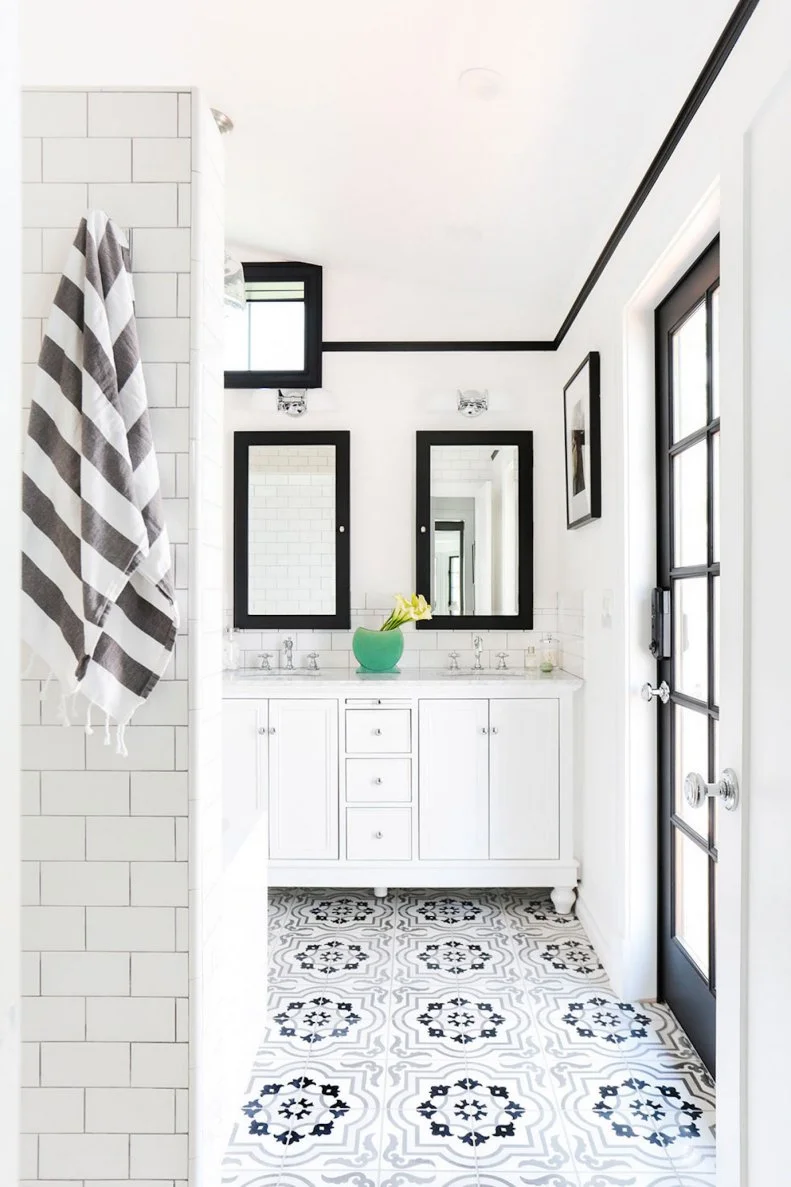
Contrast With Black + White

Use crown molding to create crisp, can't-miss definition. In this chic juxtaposition of a bathroom, thin, black crown molding pulls the ebony hue up from the floor to the ceiling and draws the eye throughout the space.

More photos after this Ad

Photo: Garett + Carrie Buell of Studiobuell/ studiobuell.com. From: Noble Johnson Architects, LLC
11 / 21

Choose Cove for Elegant Versatility

The concave profile of cove molding is ideal for softening the right angle where the ceiling and wall meet. The simplicity of the curved silhouette makes it a smart counterpart to layer with other molding pieces. For this cozy home office, the trim and moldings are painted a darker shade of the wall color, adding depth and creating an eye-catching contrast with the study's richly stained furniture.

More photos after this Ad

Photo: Ryan Garvin. From: Brooke Wagner
12 / 21

Brush Up on the Classics

Mimicking the design of Hellenic buildings, like temples, Greek Revival crown molding uses the classical elements of ogee (a S-shape) and ovolo (a convex profile) in combination with wide, flat trim boards. The finished result is eye-catching and refined without the need for carved or raised details.

More photos after this Ad

Photo: Alyssa Kirsten. From: Lauren Rubin Architecture
13 / 21

Go Big

Contrary to what you may think, rooms with low ceilings can benefit from chunky crown molding. This wide, clean-lined trim visually expands the height of the room and draws your attention to other architectural elements, like the support beams. While smaller crown moldings also work well in rooms with lower ceilings, don't be afraid to try something with a bit more heft to it.

More photos after this Ad

Photo: Jessica McClendon. From: Jessica McClendon
14 / 21

Create a Not-So-Conventional Design

This boho-chic living room is a fun combo of color and pattern that's oh-so-livable. The freewheeling style seamlessly blends midcentury modern pieces, like the sideboard and coffee table, contemporary items, like the metallic hide rug and blue velvet sectional, and traditional elements, such as the gilded picture frame and crown molding. Delicate bow-and-swag detailing brings an extra traditional touch to this Federal crown molding, a style popular after the American Revolution and into the early 19th century.

More photos after this Ad

Photo: Angie Seckinger. From: Lorna Gross
15 / 21

Go 3-D With Dentil

Composed of a series of blocks space closely together (and resembling teeth, thus the moniker), dentil molding finds its history in Greco-Roman architecture and remains a popular molding profile today.

More photos after this Ad

16 / 21

Pay Attention to the Profile

Simple and classical, a compound molding combines concave and convex profiles. Here, the cyma recta, or upright wave, has the concave part at the top of the molding and the convex part at the bottom. In classical design, if the final curve of the molding is outward — like it's reaching out rather than up into the sky — then the element is used at the top of the design, such as in crown molding.

Get the How-To

More photos after this Ad

Photo: Alise O'Brien Photography
17 / 21

Work With Your Architecture

Use the layout of your room to your crown molding's advantage. Here, the bay windows required a slightly dropped ceiling, paving the way for ornate stepped crown molding.

More photos after this Ad

Photo: Lauren Nelson Design. From: Lauren Nelson
18 / 21

Stack Your Moldings

Completely customize your space by combining a mix of crown molding elements together — ogee, filets, concave, convex, flutes, beads — the ceiling is your only limit. Though even that can be stretched by extending the millwork onto the ceiling to construct a sophisticated crowning touch.

More photos after this Ad

Photo: Baird & Warner, a member of Luxury Portfolio International. From: Baird & Warner and Luxury Portfolio International®
19 / 21

Max Out Your Height

When ceilings go high, your crown molding gets taller. No tiny quarter round needed at the edge of this soaring ceiling. The traditional bead and curve combines with a flat façade and a double bead base for scale-appropriate crown molding in this sophisticated living space.

More photos after this Ad

Photo: Dave Perry-Miller Real Estate, a member of Luxury Portfolio International. From: Dave Perry-Miller Real Estate and Luxury Portfolio International®
20 / 21

Embrace the Details

The elaborate crown molding in this dining room has the look of dentil, but upon closer inspection, you'll discover it's actually a row of elegantly carved miniature corbels. Painted in a sandy hue, the millwork blends with the turquoise-blue Venetian plaster walls for a decidedly Mediterranean feel.

More photos after this Ad

Photo: Caitlin Murray. From: Caitlin Murray
21 / 21

Deliver Color in a Simple Silhouette

Vibrant purple architectural details, from the exposed ceiling beams to the paneling and moldings, are truly the star of this living room. When working with over-the-top trimwork, use simple crown molding to create balance. Here, filet, a narrow band projecting outward to separate curved pieces or finish them at the top or bottom, and fascia, a flat surface, combine for subtle crown molding with crisp lines that brings a clean finish to the room.