
Next Up

Tour Atlanta’s Historic Oakland Cemetery

Follow Gloria on:

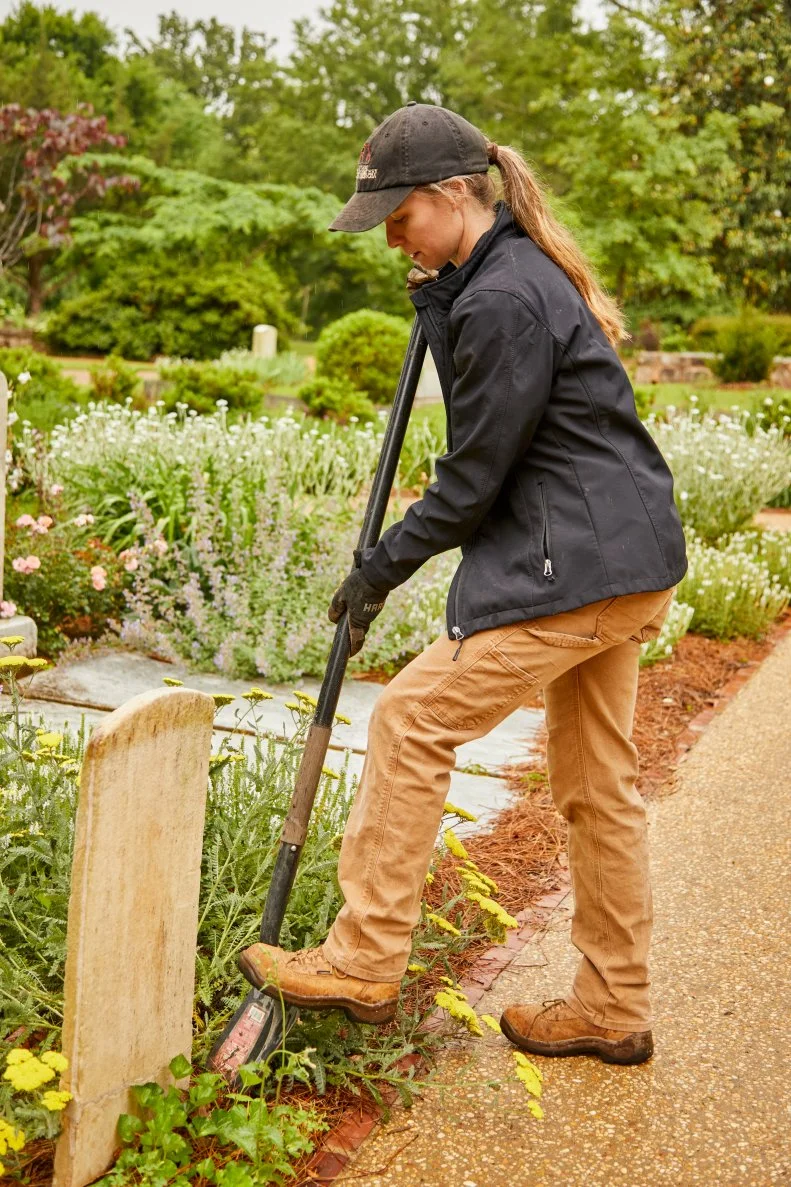
In Atlanta, a talented team of historians, preservationists, horticulturists and arborists continues to bring Historic Oakland Cemetery back to life as a go-to destination in the heart of the city.

Photo: Ari Skin / Getty Images
Scroll For More Photos
1 / 25

Graves and Gardens

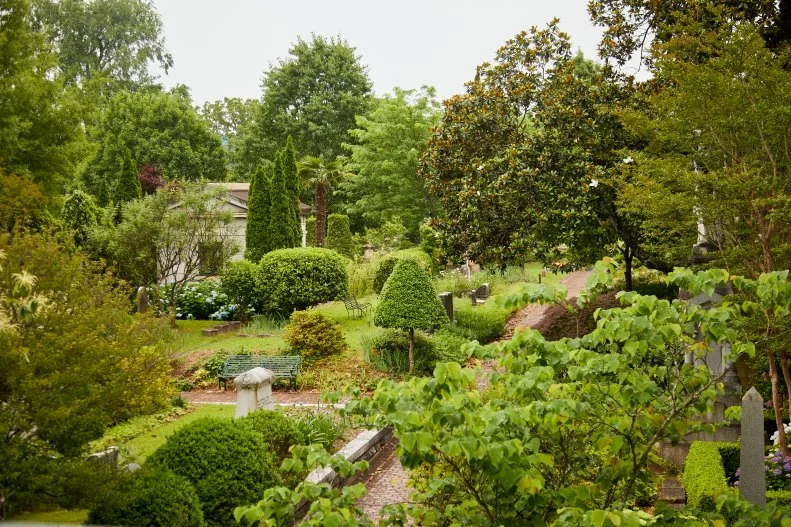
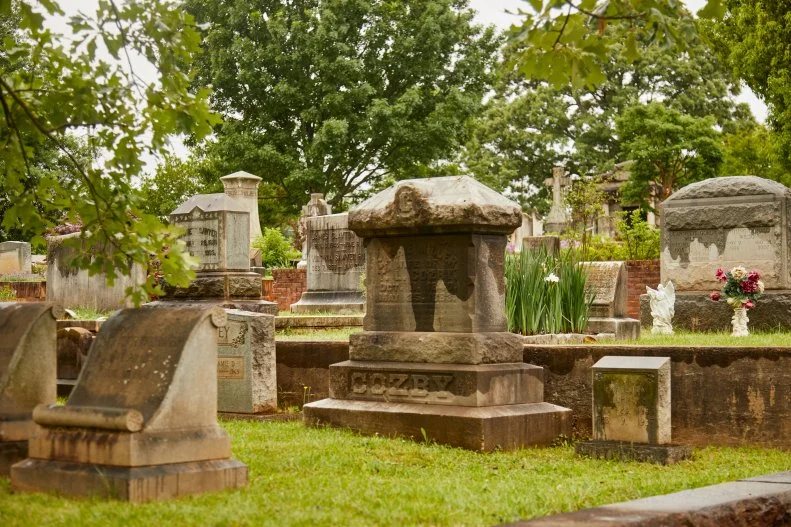
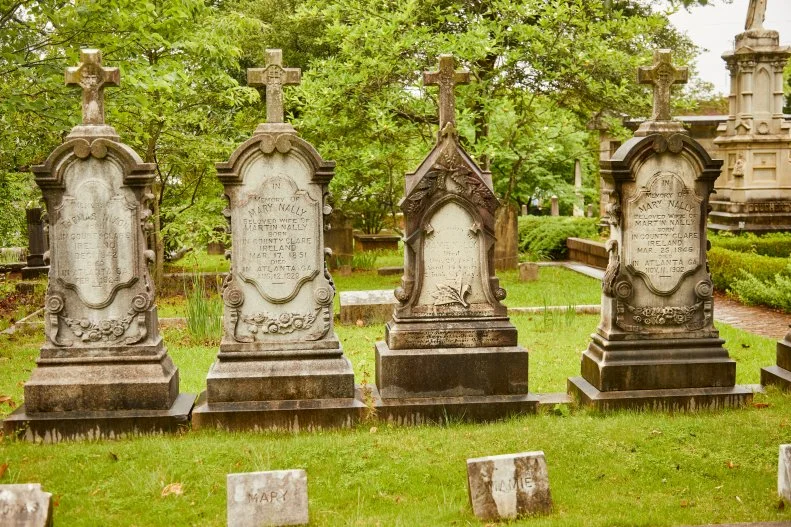
Atlanta’s oldest public park is also one of its most unusual: Historic Oakland Cemetery, a 48-acre jewel less than a mile from downtown Atlanta. Here you’ll see grand mausoleums and monuments as well as simple and crude headstones, and scan the landscape that holds thousands of unmarked graves.

And while it is the final home for more than 70,000 souls at rest — rich and poor, Jewish and Gentile, locals and immigrants, white and Black — you can also stroll along the paths enjoying the intricate and well-tended gardens, fountains and monuments. Throughout the year, you can enjoy such lively activities as festivals, celebrations, picnics, youth camps, weddings and more.

“It’s a hidden gem, and it’s a hidden garden gem,” says Abra Lee, Director of Horticulture at Oakland Cemetery. “We look at ourselves as one of the great gardens of the world, certainly one of the great gardens of the South.”
More photos after this Ad

Photo: Ari Skin / Getty Images
2 / 25

History of Oakland

Today’s 48-acre cemetery and park began in 1850 as a six-acre public burial ground, originally called City Cemetery. By 1872, it had been expanded to 48 acres with 12 distinct burial grounds, and was renamed Oakland Cemetery in honor of the many oak trees that grew within the boundaries. During the late 19th and early 20th century, families and visitors regularly came to the cemetery to honor the deceased and tend to the decorative gardens they created at individual plots, but also for picnics and other forms of relaxation.

The cemetery went through a period of deterioration from the 1930s until the early 1970s. In 1976, Oakland Cemetery was listed in the National Register of Historic Places. A small group of Atlanta citizens interested in preservation founded non-profit Historic Oakland Cemetery Inc., which took over restoration and maintenance of the cemetery. That organization later became Historic Oakland Foundation.

More photos after this Ad

Photo: Ari Skin / Getty Images
3 / 25

Interpreting the Past

Historic Oakland also holds lessons on Atlanta’s history. In addition to the Original Six Acres, the cemetery has distinct areas, each with its own unique story: African American Burial Grounds, Jewish Flat and Jewish Hill, Confederate Burial Grounds, East Hill, Greenhouse Valley, Potter’s Field and Belltower Ridge.

Much of the story of each area can be told through the hardscape — the headstones, the walls, the mausoleums, says Cooper Sanchez, a long-time contract gardener who works with the staff to maintain the Oakland gardens. But the finishing touch in each area is in the gardens that are carefully researched, planned out and tended by the knowledgeable staff.

“The headstones are fixed. But the gardens are a new interpretation," Sanchez says. “I think it’s really interesting that we’ve had the interest, the freedom and the support to tell a lot of these stories through the gardens.”

More photos after this Ad

Photo: Ari Skin / Getty Images
4 / 25

Focus on Restoration and Preservation

The staff at Oakland Cemetery focuses on three types of preservation and restoration, says Sean Diaz, Operations Manager at Oakland Cemetery: phased projects, family lot improvements and critical restoration.

“African American Grounds, Jewish Grounds, East Hill — that’s a phased project.” The work of restoration is done over an extended period of time. For family lot improvements, "They can come to us, we’ll do the work, we’re normally cheaper, we have the skills. We’re in-house.”

On critical restoration: “Every year, the preservation team walks around the cemetery and looks for hazards to either the public or the monuments themselves,” Diaz says. Headstones that are delaminating or cracking, for instance, are repaired to prevent further damage.

More photos after this Ad

Photo: Ari Skin / Getty Images
5 / 25

A Window Into History

The African American Burial Grounds, in the northeast portion of the cemetery, is an area that has recently undergone extensive restoration and preservations efforts. Those efforts reveal an important part of Atlanta’s story: “This isn't the original African American Grounds,” says Sean Diaz. “This is the second grounds. The first grounds was pre-Civil War, and it was called Slave Square, even though there were free people of color buried in that section.”

When the cemetery expanded to its full size, Slave Square became “prime real estate” for other burials, Diaz explained. “So they actually disinterred those people, moved them out here or moved them to Potter’s Field, and resold those plots to white families.” An interpretive marker at the burial grounds spells out this part of the cemetery’s — and the city’s — history.

More photos after this Ad

Photo: Jessica Yonker
6 / 25

African Americans Who Made History

There are roughly 12,000 residents in Oakland’s African American Burial Grounds, including several women and men who contributed prominently to Atlanta’s and the nation’s history. Reverend Frank Quarles, buried in 1882, is known as the founder of Spelman College and his role in bringing Morehouse College to Atlanta. Carrie Steele Logan, buried in 1900, who had been born into slavery and orphaned as a young girl, was known for sheltering abandoned children after emancipation. The Carrie Steele Orphan Home was founded in 1888 and continues to serve neglected, abused and orphaned children. Bishop Wesley John Gaines, buried in 1912, was the sixteenth bishop of the African Methodist Episcopal (AME) Church, the second pastor at Atlanta’s landmark Big Bethel A.M.E. Church and a founder of Morris Brown College. Selena Sloan Butler founded the first parent-teacher association for African Americans in 1911 in Atlanta, and established the National Congress of Colored Parents and Teachers in 1926, which merged with its white counterpart in 1970. She was named as a cofounder of the National Parent Teacher Association. Mrs. Butler was buried in the African American Burial Grounds at Oakland in 1964.

More photos after this Ad

Photo: Ari Skin / Getty Images
7 / 25

More Celebrated Oakland Residents

Historic Oakland Cemetery is the final resting place for many of the states’ governors, Atlanta mayors, musicians, writers, and other notables. Margaret Mitchell, the Pulitzer Prize-winning author of Gone With the Wind, died in 1949 and is buried here. Country Music Hall of Fame musician Kenny Rogers was laid to rest here in 2020, and his polished granite monument stands under leafy oaks. Bobby Jones, considered the greatest amateur golfer, was buried here in 1971. Visitors have placed golf balls at the base and on top of his headstone.

More photos after this Ad

Photo: Jessica Yonker
8 / 25

Mayoral ‘First’: Maynard Jackson

Maynard Jackson, who served three terms as Atlanta’s first Black mayor, is buried within the cemetery’s previously segregated Original Six Acres. His grave is marked by a black granite obelisk that faces the downtown Atlanta skyline.

“History is why I chose Oakland Cemetery as Maynard’s permanent resting place,” said former First Lady Valerie Jackson in remarks delivered at the ceremony celebrating the completion of the African American Burial Ground’s restoration project in 2021. “It’s a sacred space that records a shared history of Atlanta. The restoration only begins to reveal the depth and contributions of the African American community.”

More photos after this Ad

Photo: Ari Skin / Getty Images
9 / 25

The Path to Restoration

The process of restoring Oakland’s African American Burial Grounds began in 2016, says Ashley Shares, Director of Preservation at Historic Oakland Cemetery. ”Prior to this, we had ground-penetrating radar done to determine if and where unmarked graves were. There’s over 800 unmarked graves in this section,” she says. Some of the graves were indicated in the burial records, but some were discovered only through the radar. They raised funds for preservation to begin in a small area at first. Success there led to more fundraising to further preservation efforts.

More photos after this Ad

Photo: Ari Skin / Getty Images
10 / 25

Three-Year Project

The African-American Burial Grounds is about 3.2 acres, Ashley says, “and it was approximately a three-year preservation project, so we broke it into three phases.” After the preservation was complete, the gardens department came in to do the planting, she explained. “Hardscape, which is what we do, almost always comes before landscaping because we uncover a lot of things. And we find walls, and we find headstones that do impact garden design.” The types of monuments, the layout, and the era they are from also informs the type of landscaping that is installed. “The plants here also have an importance when it comes to our integrity of being a historic site,” she says. “You know, we’re Oakland Cemetery because of the trees. If we didn’t have any oak trees, then we’re not going to be Oakland Cemetery.”

More photos after this Ad

Photo: Ari Skin / Getty Images
11 / 25

New Discoveries, New Mysteries

Even at planting time, discoveries would still be made. “Especially in this section, because the records weren't as good and weren't really kept up,” says Sean Diaz. “When she [Janna Rhoden, Garden Technician] came through with volunteer workdays or big sod days where we were doing grass, they found even more monuments. Even to this day, they’re still finding monuments as Janna puts in new plants.”

The mystery begins, then, of who and what belongs in what spot in the burial grounds. “Which is, honestly, one of my favorite parts of this job, the investigation part of it,” Diaz says.

More photos after this Ad

Photo: Ari Skin / Getty Images
12 / 25

Recovering Lost Voices

Stories lost to history are brought to life here. Such was the case with the fragments of a headstone for Lizzie Taylor, buried in about 1883. The broken stone was discovered when a gardener who was planting in the area struck it with a shovel. Research uncovered the details that the young woman was born around 1860, worked as a laundress, and lived with her mother, Harriet, and her sister, Eliza at 64 Peach Street. She was 23 when she died.

“Her headstone was found not super far away from where she belongs,” says Director of Preservation Ashley Shares. “But the reason we didn't find her headstone when we started this project was because we looked for her headstone where it was supposed to belong. So we didn't know she was there until we started trying to plant trees during a workday, and hit some pieces.”

It’s a situation that happens frequently, she says. “That's how a lot of things at Oakland, and in this section, in particular, get discovered — completely by accident.”

More photos after this Ad

Photo: Ari Skin / Getty Images
13 / 25

A Beautiful Place to Rest

The landscape projects in the African American Burial Grounds are ongoing. “We're still enhancing it. We’re in phase three now. We’re looking to add a little bit more historical-appropriate plantings for African American landscapes,” says Janna Rhoden.

“We've been introducing a lot more natives and a lot of edibles, like blueberries, apples and things like that.” Adding the historical plantings and enhancing the space for people to enjoy it is a work in progress, she says. “I feel like the ancestors out there really appreciate it and that they deserve it. They deserve a beautiful place to rest.”

“A lot of what we do is retell these stories to the best of our ability, because we only have about 50 photos to work from,” Cooper Sanchez says. “We don’t know specifically what African American [cemetery plantings] looked like, so we work from our hearts and figure out what is the best way to honor this area.”

More photos after this Ad

Photo: Ari Skin / Getty Images
14 / 25

Gardens That Honor Earlier Times

“We look at history on African American burial practices around the Southeast that we can recognize the trends and styles, but then interpret it in our own way. And I think we've done that in every section, not just African American,” says Sanchez.

“Every single lot out here is its own garden,” adds Neale Nickels, Senior Director of Capital Projects for Oakland Cemetery. But each area strives to honor the garden styles and stories of earlier times.

More photos after this Ad

Photo: Ari Skin / Getty Images
15 / 25

Thoughtful Planting Choices

Choosing the plantings for any of the areas is a thoughtful and delicate process.

“Working in the cemetery, you’re working with families,” Abra Lee, the Director of Horticulture, says. “There are families that are what we call active and inactive. Some families are like, ‘This is my lot. This is what we want done. Don’t touch it.' And we completely respect that.” Other families prefer Oakland staff do the maintenance. “Having those discussions with them, understanding what’s important to them, what their values are — maybe even giving them the background on the history of the section that their family is in so we can make thoughtful choices in terms of the plantings there.” And Abra gives credit to staff members “who help to actually make their vision into a real, planted picture.”

More photos after this Ad

Photo: Ari Skin / Getty Images
16 / 25

Each Garden is Different

From a maintenance perspective, care of Oakland Cemetery can be challenging, Neale Nickels says. “This not the kind of place where you can come in and just do everything uniformly. It is not a copy-and-paste kind of a thing,” he says. “We have really talented gardeners who treat each garden as if it were their own at their own house. And they do an excellent job."

Volunteers also help keep the grounds in order. “We have an amazing group of volunteers and groups that come once or twice a year and help us with big sections,” Nickels says. The City of Atlanta also partners with Oakland to provide much of the landscape work, “particularly in the areas that we’ve not yet restored.”

More photos after this Ad

Photo: Ari Skin / Getty Images
17 / 25

Old World, New World Traditions

The Jewish burial grounds — Jewish Flats and Jewish Hill — are at the cemetery’s south border, and notable for its distinctive areas reflecting different burial traditions. Jewish Flats contains a section of burials of Russian immigrants, with tall, densely spaced headstones, written in Hebrew, in keeping with Russian-Jewish tradition. In contrast, the Jewish Hill site has a more Victorian vibe, with more landscaping, statuary and elaborate mausolea.

Jewish Grounds residents include several notable Atlanta citizens. Dr. Joseph Jacobs, who owned Jacobs’ Pharmacy Company, was partially responsible for the drink that became Coca-Cola in 1886. He was entombed in 1929 in the Jewish Grounds. Morris Rich founded M. Rich Dry Goods in Atlanta, which became Rich’s, one of the largest retail department store chains in the South until it merged with Macy’s in 2005. Morris Rich died in 1928 and other family members are buried in the Jewish Hill area of Historic Oakland Cemetery.

More photos after this Ad

Photo: Ari Skin / Getty Images
18 / 25

Disaster and Opportunity

In 2008, a tornado blew through Atlanta and swept away more than 100 of the cemetery’s trees, including many of the oaks and pines. After the tornado, Oakland acquired young trees through support from communities and nurseries throughout the Southeast, but it was also an opportunity to begin to level up the cemetery’s Arboretum Certification, says Aeron Attwooll, Sustainable Garden Specialist at Historic Oakland Cemetery. That accreditation would allow more collaboration with tree conservation groups.

“We want to be a very significant oak conservation arboretum,” Attwooll explains. Among the benefits, he says, is “connecting with nurseries for more specialized, rare trees and solidifying our identity as a place of oaks in Atlanta.”

More photos after this Ad

Photo: Ari Skin / Getty Images
19 / 25

Confederate Burial Grounds

Approximately 7,000 soldiers, many unknown, reside in the Confederate Burial Grounds, in the central portion of the cemetery. Among them is Gen. John B. Gordon, governor of Georgia from 1886 – 1890. He had also served as a Lieutenant General, C.S.A. and as a U.S. senator in the late 19th Century.

The Atlanta Ladies Memorial Association (ALMA) placed a 60-foot granite obelisk near the center of the grounds in memory of “Our Confederate Dead,” dedicated in 1874. In 1890, ALMA replaced the original painted wooden headboards with marble markers.

More photos after this Ad

Photo: Ari Skin / Getty Images
20 / 25

Potter's Field

A grassy, tree-dotted hillside just beyond the African American Burial Grounds is Potter’s Field, containing approximately 7,500 souls at rest, in unmarked graves, who had been among Atlanta’s poorest citizens and unknown persons of various races. “It was not the original pauper’s ground, but the most recent pauper’s ground,” says Sean Diaz. The monument placed at the edge of the field reads: “A memorial to the Citizens of Atlanta who rest in unmarked graves.”

More photos after this Ad

Photo: Ari Skin / Getty Images
21 / 25

Bell Tower Ridge

Oakland Cemetery’s Visitor Center, Museum Shop and administrative offices are in the Bell Tower, a building constructed in 1899 at the cemetery’s highest point, which came to be known as Bell Tower Ridge. Cooper Sanchez, who oversees maintenance of the grounds in many areas, remembers that this section was one of the first areas to be restored during what he calls “the renaissance of Oakland.” “So it’s sort of High Victorian, very fussy,” he says.

Bell Tower Ridge is the final resting place of members of many of the city’s most prominent families, and burial lots are generally larger in this area than in other sections of the cemetery. Elaborate mausoleums, like Richard's Mausoleum pictured here, are plentiful here. Also in the Bell Tower Ridge section is a monument dedicated to all of Atlanta’s mayors, including the 28 mayors who are buried at Oakland. A fountain near the Bell Tower with cast iron figures titled “Out in the Rain” was acquired in 1913.

More photos after this Ad

Photo: Ari Skin / Getty Images
22 / 25

The ‘Mayor of Oakland’

Any community will have its share of unusual and unexpected stories, and Historic Oakland Cemetery is no different. Visitors coming through the park’s main gate are “welcomed” by a carved likeness of Jasper Newton Smith, who was laid to rest here in 1918.

“He is the unofficial mayor of Oakland,” says Sean Diaz. “He greets all of our guests and watches over our gates as you come through.” Newton Smith was a wealthy builder, but he was also known to be claustrophobic, and fearful of being choked, Sean says, so he never wore a necktie. “When he built this statue, originally the artist included him wearing a necktie. ‘Well,’ he said, ‘I’m not going to pay for this until you take that necktie off.’ So you can see that it’s kind of chiseled off there, and smoothed out.”

Inside the mausoleum, each coffin has a shelf space, and Smith’s remains are on a shelf in a glass-faced coffin, Diaz says. “It’s another testament to his fear of claustrophobia. But it’s also interesting because you can see the decades of the different styles of coffins. You have very ornate Victorian coffins with finials, and then it kind of goes to the Art Deco era."

More photos after this Ad

Photo: Ari Skin / Getty Images
23 / 25

Events and Activities at Oakland

Cemetery restoration and preservation is an expensive endeavor, and Historic Oakland Cemetery relies on its fundraising activities for much of that support.

“We rely on our big events to raise a lot of money that allows us to not only restore the cemetery, but also maintain it in partnership with the city,” says Oakland Executive Director Richard Harker. “We have a ton of smaller programming — walking tours, tree tours, scavenger hunts, workshops.”

One of those signature events is Capturing the Spirit of Oakland Halloween Tours in October. “We have actors that bring back the stories of people buried here, and they are designed to enlighten, not frighten. So they're not scary. They're educational,” Harker says. “But people have a great time.”

New programs are being added, he says. “In the last couple of years, we’ve also launched a lot of new youth programming. We have STEM summer camps this summer. We have a workforce development program where we pay high school kids to learn landscaping jobs and hardscape jobs. We’re in a growth mode of trying to offer more, so that Oakland is really a vital community asset.”

More photos after this Ad

Photo: Ari Skin / Getty Images
24 / 25

Historic, But Still Active

Even with its park-like areas and activities, Historic Oakland remains an active cemetery, with about one burial a month. During those events, the cemetery remains open to the public, but the area of the burial service is closed off out of respect to the family, Richard Harker says. The cemetery is open to the public from dawn until dusk all year.

More photos after this Ad

Photo: Ari Skin / Getty Images
25 / 25

A Skilled and Dedicated Team

“Nothing makes me happier than when I meet someone who has walked out of the cemetery and who didn't know much about it, and they're, like, ‘Wow, it is gorgeous,'” says Richard Harker. “It is beautiful. And that, to me, is such a testament to the hard work and skill of our team who do that work.”

Team members pictured here include, from left: Neale Nickels, Richard Harker, Aeron Attwooll, Sean Diaz, Butch Teal, Angie Wynne, Abra Lee, Ashley Shares, Janna Rhoden and Erica Glasener.