

Knot Garden of Herbs

Rebecca's Garden : Episode REB-622 -- More Projects »
PHOTO

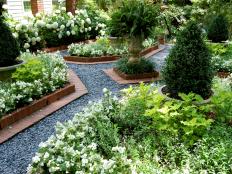
Planting herbs in a classic pattern gives your garden a tailored, formal look.
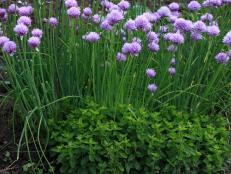
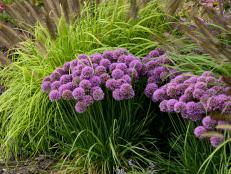
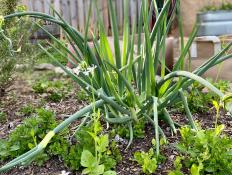
The landscape of Rebecca's Garden is constantly changing. Host Rebecca Kolls decided to revamp her overgrown herb bed. She couldn't tell one herb from the other, so she ripped almost everything out. She left a few of the anchoring plants, like the chives and the ornamental onions, because they looked terrific at each of the four corners. Next she created a knot garden out of herbs.

As the name implies, knot gardens are plants interwoven like threads in a cloth. Planted correctly, plants appear to cross over one another, creating a geometric motif. Dating back to the 16th century, knot gardens surrounded the grounds of castles to create a grand entrance. Even rows of hedges were often interwoven to create family crests and monograms.

Materials:
graph paper
colored pens, pencils or markers
stakes
string
any combination of low-growing, mounding herbs (such as sage, 'Spicy Globe' basil, opal basil, parsley)

PHOTO

This design has straight lines in a checkerboard pattern--actually a Celtic knot design.
Step 1: Make your design
If you've never planted a knot garden before, the best advice is to keep it simple, using straight lines instead of curves. That way you'll have much more success. Start out by measuring the area and then drawing it out on graph paper, with everything to scale. Draw the garden plot using one square for every six inches of garden. Don't forget to add any existing elements, like the chives and ornamental onions in Rebecca's garden. Then draw your design, using a different color pen or pencil for each herb.

Step 2: Select your herbs
Select plants with different colors and textures that are low growing and have a mounding growth habit. Plot them on your graph paper design and color-code them. For example, Rebecca chose parsley for the outer edge, and on her design the parsley appears as a lime green line. She drew a blue line for opal basil, which has a lovely purple leaf, and red for 'Spicy Globe' basil and dark green for sage.

Spacing the herbs about six inches apart will allow them to grow together quickly. To help figure out how many plants are needed, count the squares on graph paper. For her design, each square represents six inches, so one plant per square.

Step 3: Transfer design to the garden
This is the easy part; all you need are stakes and string. To find the center of the knot garden, pound a stake in each corner of the garden bed. Then attach the string to each opposing stake. The center is where the strings cross one another.

The center point is important because every part of a design is measured from the center. So pound another stake in the center. No matter what design you choose, everything has to be measured out and marked accurately in the soil. In Rebecca's design, to keep things simple, each stake was placed four feet apart.

Step 4: Position the plants
Part of the success of a knot garden is the placement of your plants. Some of the plants should look as though they're going under each other, while others will look as if they are going over. So anytime you have an intersecting line, you have to decide which line of plants will be under, and which lines of plants will be over. Your design chart will be invaluable.

Once you've laid out all the plants in the shape of your design, you can remove the string and stakes. And finally, add a focal point, such as a bird bath, in the center.

PHOTO

Spacing the herbs six inches apart provides an immediate pattern while also giving them room to grow.
Step 5: Get planting
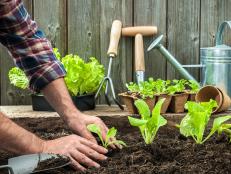
You'll probably have quite a bit of planting to do, so this might be a great opportunity to bring in your friends and have them help. Once everything is planted, it's time for the mulch. Besides retaining water and keeping weeds out, mulch provides an excellent contrast, highlighting the design.

Step 6: Maintenance
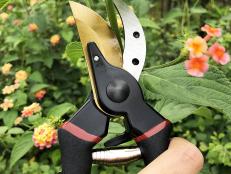
As the knot garden of herbs grows, it will look terrific, but you do have to do a couple of things. Pinch back the herbs to encourage bushier growth. Also, take scissors and manicure the sides, making sure the lines are nice and straight. The best part is that you can eat your trimmings. And to keep your plants nice and healthy, fertilize them every other week with a water-soluble fertilizer.

In a few months, your knot herb garden will grow into a woven tapestry of herbs--an aromatic and aesthetically pleasing success.