



Take a New Look at Ferns
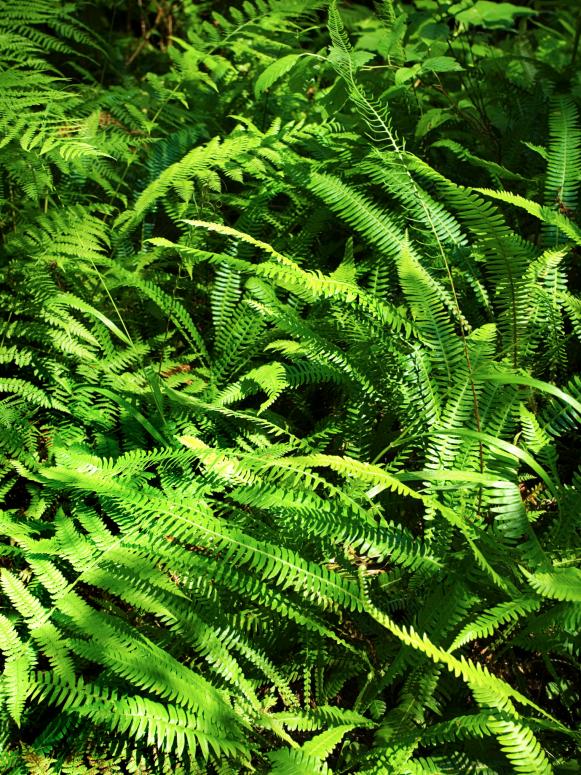
Fern reproduction is so mysterious it remained wrapped in mystery and magic until the middle of the 19th century. The reason is that - unlike all other plants - ferns don't flower and therefore produce no seeds. This led the ancients to imbue ferns with special powers, especially the power of granting invisibility. They thought that a plant with invisible "seed" must be capable of rendering people or other things invisible as well.
These "invisible" seeds meant that you could not propagate ferns except by cuttings. Ignorance reigned until the advent of the microscope, which allowed botanists to see that fern dust carried on the backs of the leaves was actually millions of single celled spores.
While I learned in botany classes that ferns reproduce by spores, I never really understood what makes a spore so different from a seed until I read A Natural History of Ferns by Robbin C. Moran (Timber Press).
Moran tells us that ferns could not be grown in quantity until the role of spores was finally documented. It proved that there are really two stages in a fern's life cycle. What you see as the green plant is actually the second phase, a stage in which the spore is sterile and bears no sex organs.
Only when a single cell spore, contained in those rusty brown clusters on the underside of a leaf, falls to the ground can the first phase of fern life cycle begins. A fallen spore grows into a prothalli, a heart-shaped flat mass of flesh with rootlike anchors to hold it against wind and water. On the surface of the prothalli are super tiny scalelike sex organs, both male and female. When water is present, sperm cells literally creep out of the scales and crawl across the prothalli to the cleft of another scale, which has at its base an egg cell.
At conception growth of the prothalli stops, ending the first reproductive phase of the life cycle. The prothalli will then produce differentiated roots, stems and leaves. Unlike all seed plants, the second-phase adult fern will never bear sex organs of its own. Ferns produce only more spores as they mature.
This illustrates the chief difference between seeds and spores. Seeds are created via sex organs on a mature plant. Spores actually become an intermediate form of plant that exists only for sex. According to Moran, the complete fern life cycle can range from just a month to as much as two to three years.