





Garden Pond and Waterfall
This waterfall-pond project can be accomplished in two weekends.
- A
- A
- A
Print Options
CloseE-mail This Page to Your Friends
xSuccess!
A link to %this page% was e-mailed
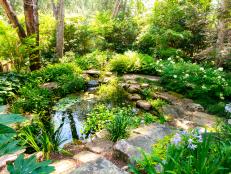
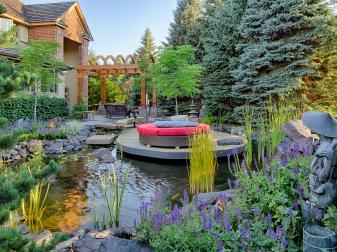
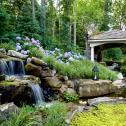
A sloped yard made this waterfall-and-pond combo a natural.A peaceful garden pond can be a beautiful focal point for your backyard. The feature built in this project involves a waterfall and a pond and takes advantage of the natural slope of a yard. In this project, the recirculating water will be pumped uphill, where it then falls naturally into a pond below. With the help of a couple of friends, you can complete this project in two weekends. If you do it yourself, expect to spend about $4,000. Hiring professionals to do it for you would cost about $7,000.
Measure out the basic width and length of the pond. Use landscaping paint to mark the ground. Next, use a garden hose to outline the shape. Our pond will measure 9'x15', but you can build a successful pond on a smaller scale. Since there are no straight lines in nature, you'll want it to have a natural, free-form shape. Once the garden hose is in place, it's easy to step back, imagine how the pond will look and make adjustments. Use landscaping paint to outline the pond.
Dig the entire pond eight inches deep (before you dig, be sure to call your utility company a few weeks ahead of time and have them mark any buried wires or cables). Remove the sod first, and continue digging, removing the soil and tree roots. Dig the walls of the pond at a 90-degree angle, because later you'll be stacking stones against them. If your soil is sandy, a slight outward pitch will work better and make the wall more stable. If you're digging on a slope, use the soil you remove to build up the edge where it slopes off to the side. If your land is flat, set the extra soil aside, because you'll use it to build up a berm or a mound for the waterfall.
Stretch a line level, which is a level that hangs on a string, across the pond to make sure the outside rim of your pond is completely level. If the pond isn't level, then the water line will be lower on one side of the pond than the other.
Once that's done, you will want to dig two deeper levels inside this area. The next level will be 16 inches deep for a plant shelf and the deepest one will be 24 inches deep to give the fish a safe place to live.
Dig down another eight inches so that the second level is 16 inches deep and about 8 to 12 inches wide. This shelf will hold rocks and plants. The contour of the shelf shouldn't mimic the outside edge of the pond; vary the shape a little to make it look more natural.
This project requires a kit that includes a skimmer, which enables the water to be cleaned as well as serves as housing for the pump. Dig a hole for the skimmer. Set the skimmer in the hole and make sure it's level side to side and front to back so water will flow into it properly. Be sure to check the instructions that come with the skimmer to find out how high to set the skimmer.
If you're building your pond on level ground, be sure and compact the soil with a hand tamp. You can rent one from a tool rental store.
Check the floor for any rocks or tree roots that could puncture the liner. Rake any loose rocks and remove them. Lay the under-liner, a woven material that will help cushion the liner and protect it from being punctured. Spread out the under-liner and conform it to the shape of the pond.
Then you are ready for the liner. It's a good idea to let the pond liner sit in the sun for about an hour to warm it up. This makes it more flexible and easier to handle. Place the liner in the center of the pond. Smooth it over the bottom and mold it up the sides, making pleats to fit the curves. Be sure to use a heavy-duty liner that's marked safe for fish. When laying the liner, be careful not to step on the ledges. You don't want your pond walls to cave in. With the liner in place (figure A), you are ready to add the stone.
Factors to consider when selecting stone:
Choose boulders that are to scale of the water feature.
Use bigger boulders at the waterfall for a more natural look.
Look for rocks that have moss and lichen to give your feature an instant aged look and add impact. Choose rocks that have rounded edges so that they looked like they've been molded by water.
Use gravel tooit's an inexpensive way to cover the black liner in a pond.
Use rock that's native to your area. The biggest cost of rock is shipping. Finding local rocks will help keep your costs down.
Now you're ready to lay the stones:
Begin laying rocks around the bottom of the pond and pour pea gravel in between the rocks to keep them from shifting. Use various sizes to make the pond look more natural.
Once the rocks are in place on the second level, connect the plumbing, pump and PVC pipe in the skimmer. The PVC pipe will run from the skimmer to the top of the hill and into the waterfall box. Following the directions that come with the kit, attach it to the pond's liner at the bottom of the hill.
Then move to the top of the hill and install the waterfall box. Dig a hole for the waterfall box and set the waterfall box in it, making sure it's level from side to side. Hook the water line to the waterfall box.
Use a shovel to dig a four-inch-deep trench to bury the pipe that will connect the skimmer and waterfall, or fall box. Next, attach the PVC pipe to the box. Replace the waterfall box and check for level. Keep checking to make sure the box is level as you backfill. If your land is flat, you can place the waterfall box on the ground and use the soil you took out of the pond to build up a berm around the box.
Waterfall and streambed
Begin working on the streambed by digging out the waterfall steps (figure B)). It's a good idea to make the steps different heights. By having some taller and some shorter, you can vary the sound of the falling water.
With the streambed dug out, repeat the process as before, installing the under-liner and liner. Start at the bottom and work the liner up the steps in one continuous piece, making folds and contouring it as you go.
Next, attach the liner to the waterfall box, following the manufacturer's directions.
Start by placing two large boulders in front of the waterfall box. Then move back down to the bottom and work your way up the waterfall, placing the largest rocks randomly along the waterfall. Use a ball cart to help move the rocks, and wear a back brace while you work.
Lay a large piece of flagstone (figure C) at the bottom of the staircase to serve as a bridge to get from one side of the pond to the other.
For rocks that aren't wedged firmly, use fish-safe black pond foam (figure E) in the crevices to secure the rocks. To help camouflage the foam, place pea gravel on any exposed foam. Once you complete the rock work, cut away the excess liner, tuck it under, and add stone and pea gravel to conceal the edge.
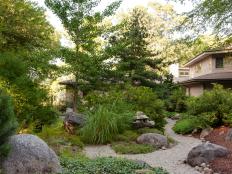
When selecting plants to place around the pond, consider sizes that are in proportion to the water feature, choosing plants that won't overpower it. If you want to use a tree, choose a small one such as a cutleaf Japanese maple. Other possibilities are dwarf evergreens, mountain laurel, leucothoe, yews, spirea.
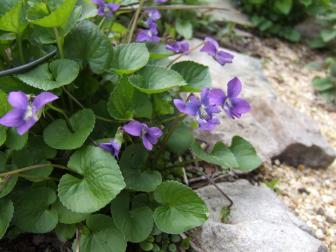
Use groundcovers such as creeping jenny, creeping fig, vinca minor, or mondo grass to help fill the nooks and crannies between the rocks. Grasses and ferns are a natural for water features because they give a sense of movement and come in a variety of height and foliage color.
Turn on the water and enjoy!
We Recommend...
Install a Garden Pond
Carter Oosterhouse shows how to add interest to outdoor areas with a soothing water feature.
Balinese Pond Garden
A cacti-cluttered space becomes a tropical getaway.
A Terraced Garden vs. a Multilevel Waterfall
With the help of an expert, neighbors compete to see who can design the better backyard.
Thought you had it covered?
Tell us what you need, and we'll help you find the best service providers in your area.
Shop Home Decor Products
Shop home decor products from rugs to mirrors, lamps and more