
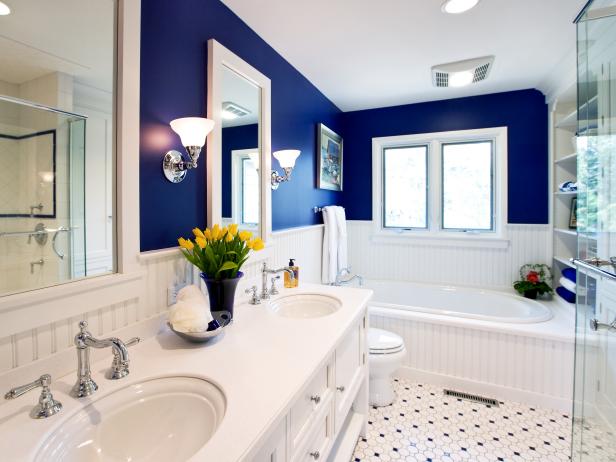
Installing Beadboard Paneling

Room by Room : Episode RXR-2103 -- More Projects »
PHOTO

Attaching beadboard paneling to a wall transforms a barren area into comfortable living space.
Materials:

paint (wall color: Woire SW6127 satin latex, trim SW6119 semi-gloss) (Sherwin-Williams)
rollers (4" and 9")
2x4 and 1x3 lumber
pre-primed beadboard paneling
circular saw with paneling blade
hammer
nails (paneling and finish)
dimes
trim and molding
nail set
paintbrushes
spackling compound
220-grit sandpaperSteps:

Note: If you're not comfortable with the heavier work of studding out walls, you can hire a contractor to do just that part of the process. To keep this project economical, attach beadboard paneling directly to the studs rather than covering them first with drywall.

1. Use a small roller to paint the edge of the studs with the final wall color in case it shows through the seams when finished due to expansion/contraction. Let dry.
2. Mark the floor or ceiling where the center of each stud is with a pencil mark or pieces of blue tape for nailing purposes.
3. To cut a panel to the necessary width, measure from a corner to the center of a stud (this allows for the next panel to be butted against it on the same stud). Transfer the measurement to the back of the paneling and draw a cut line using a straightedge.

PHOTO

Figure A
4. To cut the paneling, lay four 2x4 boards on the floor and place the paneling face down on top so two boards straddle the line of the cut. Attach a 1x3 board as a cutting guide with clamps and cut the board using a circular saw with a paneling blade (figure A). The blade only needs to be down about ¼ inch to cut through the paneling (be sure to keep the plate of the saw tight against the guide).5. Slide the cut panel into the corner and use some spacers at the bottom to keep it up 1/4 inch off of the floor. Start at the top and secure paneling nails across the panel into each stud. This will hold the panel in place while you continue down along each stud, nailing about every 16 inches.
6. Continue attaching paneling pieces along the wall, using a few dimes as spacers between the panels to allow for expansion and contraction (use the same method in the corner where panels meet).

7. Paint all of the trim before installation and let dry. To paint the paneling, start by sanding it lightly and remove the dust (this will provide more tooth so the paint doesn't sag/slide down). Cut-in around the ceiling, floor and corners, and then use a roller to apply the paint in small sections. Immediately use a brush to lay-off the paint for professional-looking brush strokes. Continue working around the room until finished.
8. Add crown and base molding and trim in the corners using finish nails. Counter-sink the nails and fill the holes with spackling compound. Once dry, sand the holes smooth and paint the trim again for a smooth finish.
Resources
paint - Sherwin-Williams
The Sherwin-Williams Company
Website: www.sherwin.com
Also in this Episode