


How to Choose the Right Greenhouse for Your Backyard
Whether you’re a beginner greenhouse gardener or you’re a seasoned pro looking to upgrade your current greenhouse, before you buy or install a new greenhouse, read our tips on greenhouse materials, placement and other considerations.

Having a greenhouse means never having to give up gardening because of the weather. You can continue to propagate seeds and cuttings and grow a variety of plants from season to season. Greenhouses can be elaborate or simple: They can be bought and assembled or built from scratch. There is truly a greenhouse to fit any budget and space.

Tomas Espinoza
This lean-to attached greenhouse is constructed of upcycled windows. Attached greenhouses share a wall with the home or another structure, benefiting from the shelter it provides.
Greenhouses are available in a variety of shapes, sizes and materials, but your options are narrowed by a few factors. For example, your home will help determine the greenhouse size, and your climate will have a say in the shape and the materials. And, since ideal environmental conditions vary from plant to plant, what you want to grow will immediately narrow your choices.
We’re going to look at how to select the perfect greenhouse for your situation. We will examine:
- the types and shapes of greenhouses available
- the costs of popular greenhouses you might buy or build
- the elements of greenhouse construction, including options for materials that you’ll encounter
- where to put your new greenhouse and how to arrange the interior.
Types of Greenhouses
Greenhouses are referred to as freestanding or attached (or abutting), which just indicates whether your greenhouse is hanging out on its own in the yard or cozied up to your home or other building on the property, sharing a wall. Freestanding greenhouses come in several shapes with unlimited customizations. The most common are the gable roof (that looks like a traditional house) and the Quonset (that looks like a half-cylinder). Other shapes include the dome, gothic arch, A-frame and slant leg. The shape of the greenhouse can affect its ability to hold heat and shed snow and rainwater.
Any shape with a flat side can be an attached greenhouse. Two common varieties are the lean-to greenhouse, with a single slope away from the house, and an even-span greenhouse that attaches to the home at a gable end. Attached greenhouses have the advantage of the shared wall providing heat during colder periods, but hot summer temperatures can add heat to the greenhouse from that same wall.


Popular Greenhouse Options
Your greenhouse can be as simple or as elaborate as your budget and space will allow. Varieties include:
Easy-Peasy
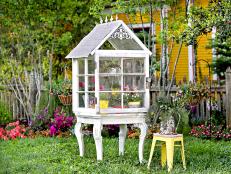
- Shelf and cabinet greenhouses provide an ultra-compact but protected vertical environment for patio growing, making them handy for apartment and small-space dwellers. Cost $50 and up.
- Small, ready-made greenhouses can be purchased online and require only basic tool-free assembly. Some are even erected like a pop-up tent. These cost as little as $100.
- A hoop house (aka high tunnel or polytunnel) is a minimally constructed Quonset greenhouse made of steel or PVC hoops with plastic stretched across it. This style errs on the side of functionality instead of aesthetics, but it is very inexpensive and easy to build. It can be bought and assembled or constructed from plans. Cost $200 to $500.
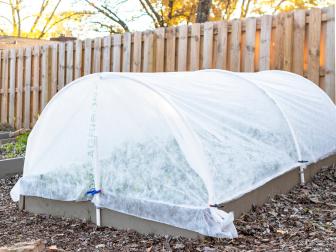
How to Build a Hoop House to Protect Your Vegetables
Extend your cool-weather growing season and even get a jump on spring with a DIY hoop house frame to cover a raised bed.
A Bigger Deal
- Speaking of plans, you can build your own greenhouse from blueprints that include a materials list that you shop for locally. Purchased blueprint plans generally run $10 to $30, but there are also free plans available online.
- Between the ready-made greenhouse and the greenhouse from blueprints are more advanced kit greenhouses that include both the directions for assembling yourself and the materials you’ll need to do it. The kits can be quite sophisticated and are often customizable through the manufacturer. These greenhouses are $1,000 and up.
- Of course, you can hire a contractor for a custom greenhouse, which is more frequently done when you want a permanent structure with utilities that match your home construction or a sizable conservatory. The cost for a custom greenhouse starts at $5,000 but is generally much more.

The Best DIY Greenhouse Kits and Plans 9 Photos
A custom-built conservatory or hothouse can be very expensive — save money and build your own. Start with DIY greenhouse blueprints and step-by-step instructions to make it easy and stress-free.
Portable and Personal
- You may have missed them on the way to the conservatory, but there are bed greenhouses, too. These plant-specific greenhouses are meant to be moved around the garden as needed. A cold frame is simply an openable box with window sides and a lid but no bottom. Placed over a section of plants, a cold frame is useful for propagating or for a bit of extra warmth for delicate flora during weather transitions. You can make your own from building salvage or buy one for $40 and up.
- The cold frame’s curvaceous cousin is the mini grow tunnel, which is a bed-sized hoop house. You can buy the frame supports to construct the perfect size for your plants. Cost for all materials: $20.
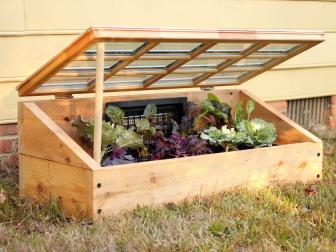
How to Build a Cold Frame 15 Photos
Protect your plants from frost with this inexpensive, easy-to-make cold frame.
Greenhouse Construction
As you’ve no doubt noticed, greenhouses come in a variety of materials and which you choose will impact greenhouse cost, durability, portability and your options for utilities.
Greenhouse frames vary significantly in strength. If you live in an area with substantial snowfall or gusty winds, make sure you select a greenhouse frame that can withstand nature’s challenges.
- Plastic piping makes for a lightweight, inexpensive frame that allows for portability but isn’t a good choice if you want a sizable greenhouse and you live in a windy area.
- You'll find many greenhouses are made from aluminum, which is lightweight, weatherproof and inexpensive.
- Galvanized steel is lightweight, sturdy and won't rust. It’s a great choice for areas with inclement weather because it can withstand weights up to 100 pounds and winds up to 70 miles per hour.
- Wood is beautiful but be sure to choose pressure-treated lumber, cedar or redwood for weather resistance.
You have options for greenhouse window glazing, too, with the qualities of durability, light transmission and insulation varying, along with cost.
- Glass is the most attractive by all accounts, but it is heavy, fragile and expensive.
- Polyethylene film plastic is economical but not very durable nor insulating enough for colder regions.
- Polycarbonate is the most common rigid plastic. It provides good insulation and good light transmission at an inexpensive price. It is durable but can yellow over time.
- Acrylic (aka plexiglass) is a rigid plastic that allows for curved panels. It’s often more expensive than polycarbonate but has good durability and light transmission.
- Ethylene Tetrafluoroethylene (ETFE) film doesn’t yellow over time like polycarbonate, is highly durable and has better light transmission than anything else. It isn’t in widespread use in the US yet, but we’ll likely see more of it.
Greenhouse floors need to have excellent drainage and can be made of concrete, stone slabs, brick, sand or even dirt. The material you choose will impact the temperature and humidity in your greenhouse. Gravel floors provide excellent drainage and can be used in conjunction with a weed barrier to keep weeds from growing up through the rocks. Soil floors can be used as a heat sink with a properly insulated foundation.
Heat, cooling, ventilation and circulation are of the utmost importance to a greenhouse. After all, if we wanted the climate outside, we wouldn’t have gone to the trouble, right? Your plants will have minimums and maximums they’ll tolerate as well as ideal temperatures. To meet these goals, you may need to add heat using small space heaters or a more advanced heating system, as well as remove heat using vents and fans.
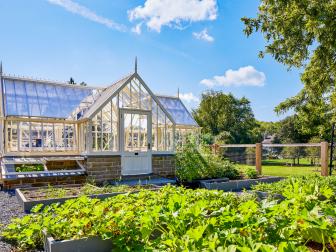
How to Heat a Greenhouse
Learn the essentials of greenhouse climate control.
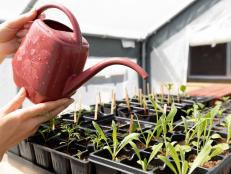
Now that you’ve put a roof over your plants, you’ll need to plan for irrigation. This can be as simple as a watering can or a high-tech automated system that incorporates misters, sprinklers and soil irrigation.
Lighting is needed in most greenhouses — to supplement natural sunlight during particular times of the year, to encourage plant growth phases and to help the growers see what the heck they’re watering.
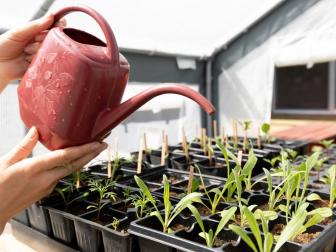
Water and Lighting in a Greenhouse
Water and light are essential to plants, and in a greenhouse, you'll provide both.
Siting Your Greenhouse
Figuring out where to put your greenhouse is a crucial decision and will inform your purchase by limiting the size and shape you can accommodate. There is much to consider when choosing a site.
RossHelen
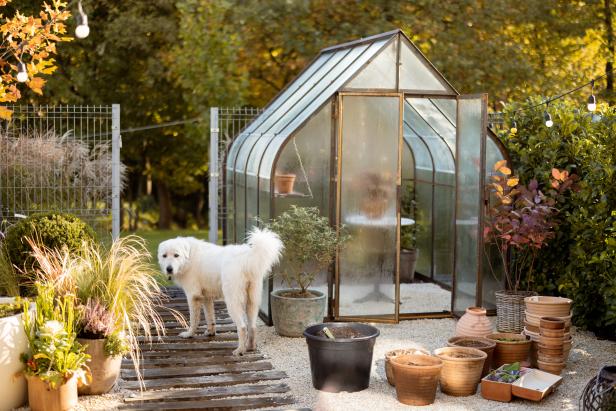
A hedge provides shelter to one side of this beautiful little greenhouse. The pea gravel floor offers some insulation, good drainage and a hard enough surface for traffic. The French doors will permit a wheelbarrow or oversized planter to enter without drama.
- Sunlight and orientation: Sun-loving plants need six hours of sunlight a day at minimum, but usually more. The less you have, the more artificial light will be needed. Southern exposure is best; eastern exposure is great; northern exposure is probably too shady.
- Exposure vs. shelter: Too much shade results in poor growth, but if the greenhouse is too exposed, it will be costly to heat and hard to cool. Look for trees, shrubs and structures that may cast productive shade during the hot season. Protection from wind will also keep the greenhouse sturdy for longer. An attached greenhouse benefits from the shelter of the home wall it shares.
- Proximity: You’ll want the greenhouse positioned conveniently for utility access. Placing a greenhouse against a house makes connecting water, gas and electricity easier.
- Approach: The area in front of the greenhouse should be clear of obstacles and the path leading to the greenhouse should be level and wide enough for a wheelbarrow. Be sure the ground is hard enough to withstand wheelbarrow traffic.
- Foundation: Be especially careful to choose a level area where water doesn't collect. Many foundations are dug in and then filled with concrete. Plan ahead when possible; the less frozen, wet or snow-covered your yard is, the easier it is to lay the foundation. Contractors can thaw frozen ground and move snow, but it costs more.
- Codes and permits: Zoning and building codes apply to greenhouses, particularly in urban areas, so consult your local building and codes department before you go too far down the rabbit hole. A freestanding structure will be treated differently from one attached to the home, and a portable greenhouse may be excluded. Your HOA may have something to say about it too.
Organizing the Greenhouse Interior
Now that you’ve chosen your greenhouse and constructed it in your desired location, you need to organize the interior, and using every inch of space is essential.
Richardson Architects
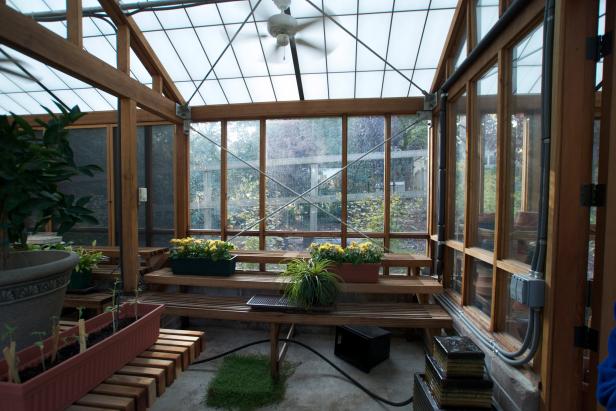
Plants can thrive in this property's expansive greenhouse equipped with state-of-the-art ventilation and watering systems. Wide aisles and staggered benches provide useful space to move and to work.
- Don’t forget to leave yourself sufficient room to work and move around. Walkways should be 18” at a minimum but the main aisle should be wide enough to accommodate awkward activities like moving soil. Don’t make your beds deeper than you can comfortably reach.
- Staging areas give you more usable space by being affiliated with a particular task. These are places where tables and benches are set up to act as plant stands or work areas for potting plants and filling flats.
- If you plan to start new plants from seed, you should include a propagation area. Seeds need more warmth than other plants in the greenhouse, so this is a very localized way to heat one area of the greenhouse without raising the entire greenhouse temperature. Use a germination mat because it heats the bottom of a seed tray and thereby stimulates growth.
- Freestanding shelving units can be moved around to accommodate plants during different seasons then removed from the greenhouse when not in use. Look for ones made of durable plastic and fiberglass, materials that are rust- and warp-proof. When setting up a freestanding area, leave a generous gap between the back of the shelving and the side of the greenhouse to allow for air circulation.
- Plan lower shelves and areas under shelves for storage.
Planning and setting up a home greenhouse can be a lot of work, but gardeners generally have no regrets. If you're a beginner greenhouse grower, starting with one of the temporary structures for a season may be the way to go. That said, a permanent greenhouse rarely goes unused. Even if you outgrow your green thumb you'll have space for an art studio, a she-shed or just a quiet sunny spot to enjoy your morning coffee.
Shop for Greenhouse Essentials


36 Greenhouse Design Ideas That Will Inspire You 36 Photos
A greenhouse allows you to garden all year long, no matter the weather. Find greenhouses for every style, budget and setting, plus get tips on how to set up and maintain a greenhouse.