




How to Care for Your Lawn
Learn how to properly care for your lawn all year round with our expert tips on mowing, watering and feeding your grass.
- Excerpted from How to Grow Practically Everything
- A
- A
- A
E-mail This Page to Your Friends
xSuccess!
A link to %this page% was e-mailed
A verdant lawn makes a wonderful foil for flower borders and creates an emerald focal point in winter when color is in short supply. There are different types of turf for different situations but all lawns benefit from regular mowing, and care and attention in the spring and autumn.
Mowing
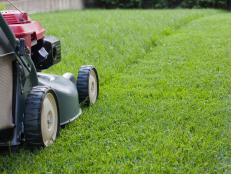
Mow grass whenever it is growing, provided the ground isn't too wet or icy to walk on. In spring, mow once a week with the blades at their highest setting, and gradually lower them as growth accelerates. Use a box to collect the clippings, which can be composted, or use a "mulching mower" which doesn't remove the grass but chops it into fine pieces, returning nutrients to the lawn. Rake off thick patches of clippings, which will damage the turf. In summer, a high-quality lawn may need cutting three times a week, but in autumn, as growth slows, once or twice a week should suffice.
Enlarge Photo+Shrink Photo-DK - How to Grow Practically Everything © 2010 Dorling Kindersley LimitedWatering
In dry periods, water newly laid turf, freshly sown areas, and high-quality lawns. Leave established lawns unwatered, but stop mowing because longer grass helps protect the roots. The grass may turn brown, but will recover once it rains.
Water a new lawn every week in dry spells, until it is established. You can tell when fine lawns need watering because they lose their spring when walked on. Reduce water evaporation by using sprinklers early in the morning or at night. Move seep hoses by 8 inches every half hour.
Enlarge Photo+Shrink Photo-DK - How to Grow Practically Everything © 2010 Dorling Kindersley LimitedFeeding
The amount of fertilizer you need to maintain lush green grass depends on how rich the underlying soil is, and if you occasionally leave the clippings on the lawn, which help top up the soil nutrients. Apply granular or liquid lawn fertilizer at least once a year. Spring and early summer feeds are high in nitrogen to boost leaf growth; products for use in early autumn are low in nitrogen but high in potassium to aid grass roots in winter. Do not overfeed because it can result in weak growth and fungal problems.
Divide the lawn into a grid of yard squares using stakes. Apply fertilizer at the rate according to the package. Rent a calibrated spreader for large lawns, and water if it doesn't rain within three days after feeding.
Enlarge Photo+Shrink Photo-DK - How to Grow Practically Everything © 2010 Dorling Kindersley LimitedExcerpted from How to Grow Practically Everything
© 2010 Dorling Kindersley Limited
We Recommend...
How To Prepare Your Lawn and Garden For Fall
Gardening expert Paul James offers advice on fertilizing, seeding and planting.
How to Care for Your Plants
Not everyone knows how to properly care for plants. Here are the basics when it comes to light, water and food.
How to Care for Your Living Christmas Tree
Here's how to help ensure that your living Christmas tree will thrive for years to come.
See Also:
From our Sister Sites:
- How to Fertilize Your Lawn and Garden (from HGTVGardens)
- How to Choose Landscaping Materials for Your Garden (from HGTVGardens)
- How to Prepare Your Lawn for Winter (from HGTVGardens)
Shop Outdoor Products
Shop outdoor products from fire pits to outdoor furniture, planters and more