
Polymer Clay Pendant and Necklace
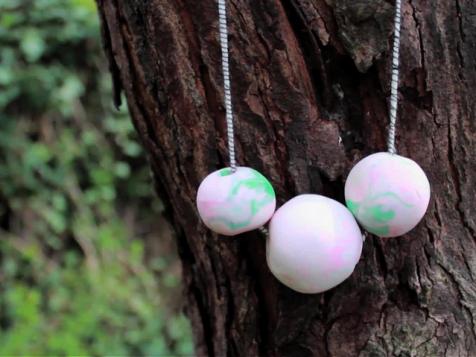
Karen Lorraine has found a way to incorporate her highly-tuned drawing skills into her work with polymer clay. The end result is finely crafted jewelry with such realistic hand-drawn images, you'd swear they were photographs.
- A
- A
- A
Print Options
CloseE-mail This Page to Your Friends
xSuccess!
A link to %this page% was e-mailed
Thanks to Karen Lorraine of Gresham, Oregon for this project.
Materials and Tools:
pasta machine or rolling tool
tissue blades
rubber stamps or texture plate
hard cutting surface
1 block translucent polymer clay
4 blocks pearl colors (or mix your own)
translucent liquid polymer clay
sealant (polyurethane or acrylic)
various glass beads
2 crimp beads
2 jump rings
head pin
necklace clasp
set of oil pencils
Steps:
1. To make a mini mokume gane: Of each of four pearl colors, you will need about a thumb-sized piece. Condition the clay by kneading it or putting through the pasta machine several times on setting one.
2. Roll each of the four colors into a flat, rectangular sheet that's about 1/8 inch thick or on setting one of your pasta machine. Put two sheets together like a sandwich and roll them to 1/8 inch. Repeat for other two sheets. Put these two sheets together so all the sheets are together, and roll to 1/8 inch thick. Cut the combined sheet in half and put the two halves together. Roll this to 1/8 inch thick. Repeat this step two more times. You should end up with one sheet with 16 layers at 1/8 inch thick.
3. Make impressions on the surface of this sheet with rubber stamps (figure A). Impressions should be about 1/16 inch thick. Alternately, put the clay on a texture sheet and run through pasta machine at setting one and remove texture sheet.
4. With the clay sheet on a flat surface, shave off the impressions (figure B). Save the shavings. Run the shaved sheet through the pasta machine on two or three, or roll the sheet to smooth the surface.
5. To make the bead: Condition a ball, about the diameter of a nickel, of translucent clay.
6. Cut a circle, about the size of a silver dollar, from the mini mokume gane. Wrap the circle around the translucent clay ball (figure C). Make sure there’s enough translucent clay showing for your drawing. Place some of the shavings around the translucent clay.
7. Smooth the surface of the bead by gently pressing, squashing and rolling. Make the bead into the shape you want and make a stringing hole with the head pin (figure D).
8. Bake the bead at 275 F degrees for 20 minutes. Use an oven thermometer, since ovens are rarely accurate.
After the bead has cooled, wet sand it with 320-grit wet/dry sandpaper.
9. Draw on the translucent part with your oil pencils (figure E). Heat set the drawing in the oven at 200 to 275 F degrees for 5 minutes.
10. To seal the drawing: Let the bead cool; then apply a thin layer of translucent clay. Bake at 275 F degrees for 12 minutes. Lightly sand with 400-grit wet/dry sandpaper. Repeat three more times.
11. To finish the bead: Sand with 400-, 600-, 1000-, 1200- and 1500-grit wet/dry paper sequentially. Coat with a polyurethane or acrylic sealant. Let dry at room temperature; then heat set with a hair dryer on high for 1 minute.
12. To make the necklace: Choose a length (16, 18 or 20 inches works for most). Add 3 inches for working on the ends and add twice the length of your bead. Cut this length of flexible beading wire.
13. On one end of the wire, thread a crimp bead and a jump ring. Fold about 1-1/2 inches of the wire over and thread back through the crimp bead. Crimp the bead to hold the jump ring in place.
We Recommend...
Polymer Clay Carved Bead Pendant
Rubber stamps make this a great introduction to the art of carving polymer clay.
Floral Polymer Clay Pendant
Donna Kato uses her own "component caning" technique to craft a beautiful flower pendant.
Polymer Clay Matchbox Pendant
Lisa Pavelka shows how to craft a unique and creative polymer clay matchbox pendant.
Shop Home Decor Products
Shop home decor products from rugs to mirrors, lamps and more