
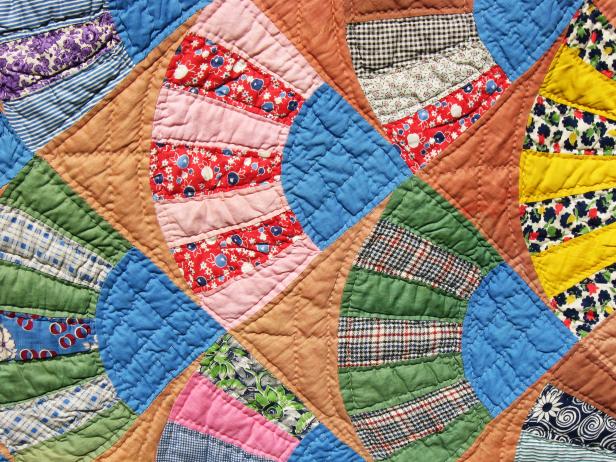
Appliqued Kid's Art Keepsake Quilt
Lorrie Kim stitches a great creation inspired by kids' drawings.

- A
- A
- A
Print Options
CloseE-mail This Page to Your Friends
xSuccess!
A link to %this page% was e-mailed
Appliquéd Kid's Art QuiltMaterials and Tools:
artwork drawn by children
ruler
calculator
pencils, light and dark
printer paper
photocopier
double-sided fusible webbing
thread and needle
straight pins
scissors
sewing machine with zigzag stitch
quilting foot for sewing machine
iron and ironing board
tearaway fabric stabilizer
5 squares of cotton calico A, 12-1/2" x 12-1/2" each, for background
4 squares of cotton calico B, 12-1/2" x 12-1/2" each, for shadow blocks
2 strips of cotton calico C, 3-1/2" x 36-1/2" each, for border
2 strips of cotton calico C, 3-1/2" x 42-1/2" each, for border
45" x 45" cotton calico D, for backing
45" x 45" cotton quilt batting
1 continuous pieced strip of cotton calico E, 2" x 200", for binding
safety pins
rotary cutter and cutting mat
seam ripper
Steps:
1. Select five images of artwork drawn by children for your kid's art quilt.
2. Calculate how much bigger or smaller the images need to be to look good on a 12-inch square background. For example, if you want the appliqué to be as close as possible to 8" x 8" there will be 2 inches of border around the appliqué to fill a 12-inch square. If the longest side of the drawing is 7 inches, enlarge the image by 114 percent (8 divided by 7 equals approximately 1.14); if the longest side is 9 inches; reduce the image to 89 percent of the original (8 divided by 9).
3. Make a black-and-white photocopy of all five images, reducing or enlarging as necessary. Make extra backup copies.
4. Cut out the images to create appliqué templates. Cut one pattern piece for each different fabric you intend to use. For example, if one image is a person, you might cut the photocopied image into eight separate pieces for the hair, the face, the shirt, each hand, the pants and each foot.
5. Choose the fabric you will use for each template piece.
6. Adhere fusible webbing to the backs of the chosen fabrics.
7. Trace the template shapes onto the fabrics in pencil. Use a light-colored pencil for dark fabrics. Transfer any markings that will be embroidered later.
8. Cut out the fabric pieces along the tracing lines.
9. Peel off the fusible backing. Carefully reassemble the fabric pieces onto the 12-1/2 inch squares of background fabric. Pin in place and fuse the appliqué fabric pieces onto the background fabrics with an iron.
10. Cut stabilizer slightly smaller than the squares. Place the stabilizer under the background fabric.
11. Topstitch along the outline of each piece.
12. Sew a zigzag satin stitch along the outline of each piece on top of the topstitching.
15. Tear away the stabilizer. Remove the stabilizer along the edges of the zigzag stitching with a seam ripper.
16. The five-appliqué blocks are finished. Stitch them into a nine-patch square, three rows of three (similar to a tick-tack-toe grid), alternating appliqué blocks with shadow blocks of fabric cut 12-1/2 inch square. Stitch with a 1/4-inch seam allowance.
17. To add borders, stitch the 36-1/2 inch strips to the left and right sides of the quilt top, and the 42-1/2 inch strips to the top and bottom.
18. To make the quilt sandwich, lay the backing fabric on the floor, right side down. Lay the sandwich on a carpet or tape the edges to the floor to stabilize the quilt. Lay the cotton batting over it. Lay the quilt top over the batting, right side up.
19. Hold the layers in place by pinning them with safety pins about every 6 inches.
20. Machine-quilt using a quilting foot. Outline the quilt around the images and free-motion quilt in the shadow blocks. Remove the pins as you stitch.
21. Machine-stitch the binding fabric to the outer edges of the appliquéd kid's art quilt, right sides together, mitering the corners. Turn the binding fabric to the back of the quilt and hand-stitch.
Lorrie Kim is devoted to her family, including her husband, her cat and especially her almost 2-year-old daughter, Iris. A former journalist and writer in the world of professional ice skating, she now enjoys spending her days chasing Iris around instead of a story. But her creative side still gets a workout at her sewing machine, making some of her clothes and even transforming artwork from friends' kids into keepsake quilts.