

From the Terraces
A look at a lovely hillside garden.
- A
- A
- A
Print Options
CloseE-mail This Page to Your Friends
xSuccess!
A link to %this page% was e-mailed
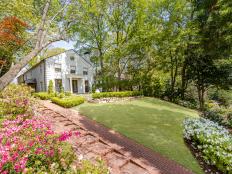
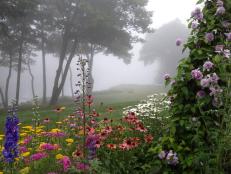
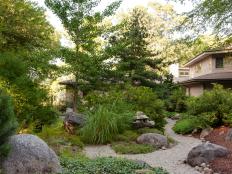
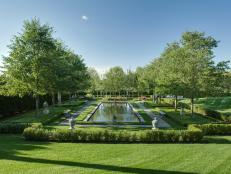
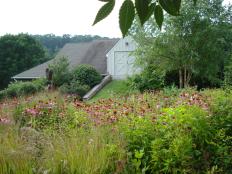
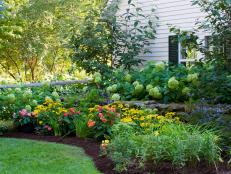
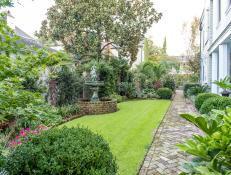
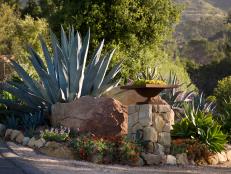
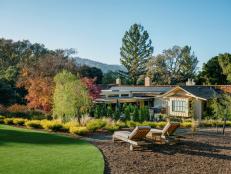
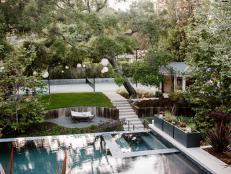
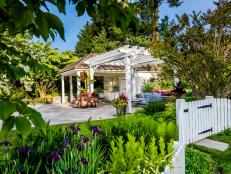
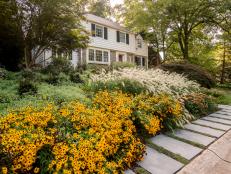
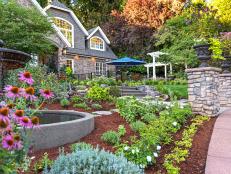
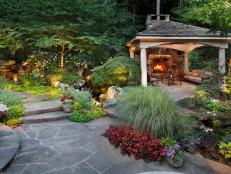
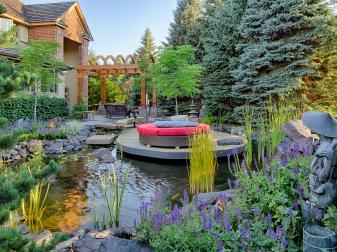
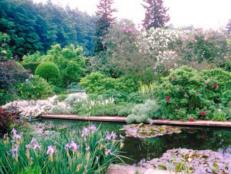
Virginia Israelit in her gardenVirginia Israelit's hillside garden in Portland, Ore., began in 1988 when she had local garden designer Michael Schultz plan a rose garden. In the years since, the garden has expanded to include a steep terraced slope full of grassy spaces with shrub and perennial borders on each side.
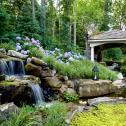
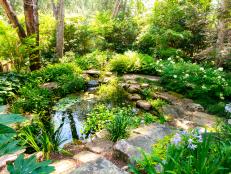
The parking area of the Israelits' house is bordered on one side by a steep hill, which they've filled with tropical plants and a waterfall inspired by a trip to the Singapore. Another intriguing area close to the house consists of a rhododendron hedge under planted with large hostas. Variegated boxwoods add color and textural interest to this portion of the garden.
At the bottom of the terraced lawns is an herb garden designed and installed by Virginia's daughter. The greenhouse next to this garden is entered through an arbor covered in grapevines.
In the lowest corner of the property, Israelit and Schultz collaborated on an unusual pergola. Pear trees have been planted in a circle, and the tops have been trained into a tall dome. Other interesting areas include a large, sunny perennial garden, a jungle-like path that leads downhill from the parking area and the expansive balcony overlooking the garden.
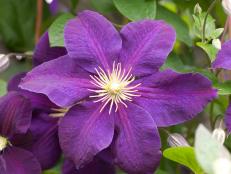
Clematis (Clematis 'Romantika')
The plant: This clematis was raised by Uno Kivistik of Estonia and introduced in 1983. The single flowers are four to six inches wide and start out as very rich, dark purple. As the flowers mature, a lighter purple bar in each tepal becomes apparent; the stamens are green-yellow. This moderately vigorous, deciduous climber can grow from six to eight feet. Hardy is USDA Zones 3-11.
How to use it: On a pillar, tuteur or climbing up a porch railing or on a fence.
Cultivation: Grow in good garden soil with good drainage. Prune the plant in spring or delay pruning half of the plant for extended bloom.
Source: Merry Gro Farms, Inc.
Foxglove (Digitalis purpurea 'Pam's Choice')
The plant: This biennial foxglove has distinctive markings. White bell-shaped flowers are spotted and blotched with dark maroon. Deer and rabbit resistant, 'Pam's Choice' grows three to four feet tall with a rosette of leaves at ground level. Depending on the climate, it will bloom in late spring or early summer. Attracts hummingbirds and butterflies. Hardy in USDA Zones 5-8.
How to use it: This is a very showy flower that looks great in a border with peonies, roses, columbine and iris. Since it has unusual markings, a few clumped together could easily stand alone as a specimen planting. Good cut flower.
Cultivation: Grow in fertile, well-drained soil in sun to part shade. Plant away from livestock, as the plants are poisonous.
Source: Michigan Bulb Company
Plantain Lily (Hosta. 'Gold Standard')
The plant: One of the most popular hostas, 'Gold Standard' was introduced in 1976. The vigorous perennial has two-toned leaves which start out in spring with a light green center and darker green margins. As the season progresses, the center becomes a golden color. Lavender flowers appear on 18-inch stalks in summer. Hardy in USDA Zones 3-8.
How to use it: Because of its habit (the leaves grow horizontally), 'Gold Standard' makes an excellent ground cover. Clumps can cover 36 to 48 inches. Beautiful when combined with solid green or solid gold hostas, as well as with ferns.
Cultivation: Plant in moist, well-drained fertile soil. The ideal for this hosta would be to receive morning sun and afternoon shade. If the plant is in too much sun, the gold center will fade to white.
Source: Bluestone Perennials
Stonecrop (Sedum spathalifolium 'Cape Blanco')
The plant: The beautiful Pacific Northwest native boasts handsome rosettes of fleshy green leaves that appear to be dusted with a silvery powder. A winner of England's Royal Horticultural Society's Award of Garden Merit, the perennial is easy to grow for beginners, is drought tolerant and deer resistant. Yellow flowers appear in summer, but it is the foliage that is of ornamental value. Hardy in USDA Zones 5-9.
How to use it: Good for maritime climates as a ground cover and also, an excellent choice to plant in the nooks and crannies of a stone wall. A rectangular trough full of this striking sedum would look great on a deck or patio.
Cultivation: Needs perfect drainage and full sun. Short stem pieces can be broken off for easy rooting.
Source: Joy Creek Nursery
Rodgersia (Rodgersia sp.)
The plant: A moisture-loving leafy perennial native to China. In the spring, the large-pleated leaves unfurl to a light green. Later, the foliage becomes bronze colored. The finger-shaped, five-lobed leaves are 10 inches long and six inches wide. The yellowish white flowers occur in foot-long spray-like panicles. Plant size is three to five feet tall. Hardy in USDA Zones 6-9.
How to use it: Beautiful when combined with annual tropical plants or at the edge of a pond.
Cultivation: This is actually a bog plant and needs constant moisture and is not drought tolerant. Site in bright shade.
Source: Wayside Gardens
We Recommend...
After Easter, Don't Toss the Lilies: Plant Them
Find out how when to plant lilies and how to pick out the right one at the floral shop.
Products From Bringing the Indoors Out
(7 photos)Keeping Squirrels Away From Tomato Plants
Master gardener Paul James puts up his defenses against a common tomato raider.
See Also:
From our Sister Sites:
Shop Home Decor Products
Shop home decor products from rugs to mirrors, lamps and more