


Eliminate Boring Landscapes by Building a Berm
Small or large, berms take any landscape to the next level.
- A
- A
- A
Print Options
CloseE-mail This Page to Your Friends
xSuccess!
A link to %this page% was e-mailed
All About
Ever think your landscape is boring and flat? Well, you can add trees, grass and flowers but for a total makeover, landscape designer Michael Glassman suggests a berm.
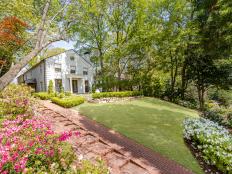
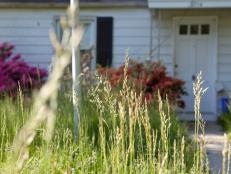
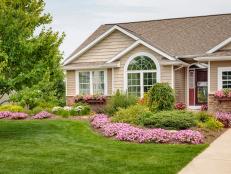
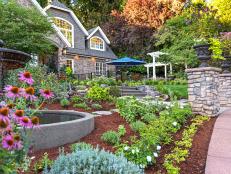
"A great landscape is like a symphony," he says." There are highs and lows, drama, whimsy and an unmistakable feel." However, the cottage garden in question (figure C) has no crescendos and no peaks. Sure, it's cute and colorful, but it needs an upgrade.
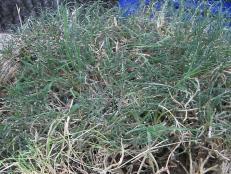
What is a berm? In the Glassman dictionary, it's an acronym. B is for beauty. E is for elevation. R is for retention of water, and M stands for movement of air and sound. To create a focal point for the area, Glassman creates a berm. But the first thing to do is get rid of the grass. "I know that lots of berms are covered in grass, but I want to accentuate the cottage feel of the house," says Glassman.
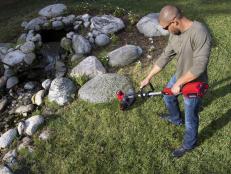
Try to keep the rocks close together to keep the dirt in the berm area (figure F). He also recommends wearing gloves. "These rocks will rip your hands to shreds."
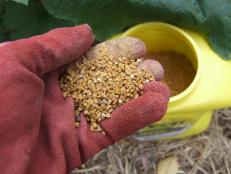
Homeowner John gets some help from the neighbor to bring in the first load of soil, a blend of 70 percent top soil and 30 percent compost. The blend provides plants with a healthy start. Fill in the bottom of the berm, and pack the soil down with a few stomps. Add soil to the middle of the berm to create a sloping mound that crests in the center. As the berm takes shape, Glassman repeatedly steps back to analyze the overall shape. "It looks a little like a fat sausage, so I'm going to make it a little bigger in the front and add a moss rock in the back--a bigger rock, one to break the symmetry in the center--and another on the opposite end." By making those slight adjustments, Glassman creates more interest and depth.
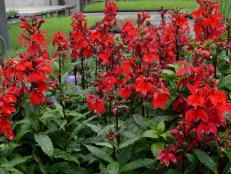
According to Glassman, landscaping is a lot like moving furniture. "If it doesn't look right, move things around." However, landscape rocks can be very heavy, so don't mess with the big ones; have those professionally moved with the proper machinery. Roll smaller rocks (figure G) in place. In choosing plants, one rule of thumb is to keep continuity. "I wanted to keep the same look as we have in the back border--like using the Red Carpet roses. Some of the new additions are penstemon, scabiosa, and an incredible 'Crystal Palace' lobelia.
But the real focal point on this berm will be trees. There will be two magnificent 'Little Gem' magnolias that will flank each side, and a deciduous wisteria that was grown as a tree rather than a vine will be positioned in the middle. The trees, of course, will need deeper, more thorough watering than the other plants in the berm.
The solution is to create a baby berm. Occasionally you're going to have problems with berms because of erosion and water problems. "So I will put a berm within a berm," Glassman says. To stop water from running down the hill, away from the trees, he builds a berm basin around the base of the trees to corral the water and funnel it to the thirsty roots (figure H).
"Finally, the real transformation occurs by placing and planting the flowers and foliage (figure I).
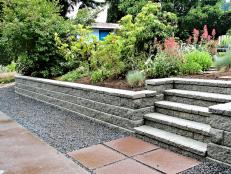
The berm adds beauty, elevation, water retention and movement. But Glassman has one last idea to make this landscape pop even more: "We've talked about the privacy a berm makes and a pathway between the bed and berm provides some nice opportunities." By creating a path, the two areas become distinct. Glassman uses decomposed granite for the path because it makes a great walking surface with a natural yet functional feel (figure J).
With the addition of the decomposed granite walkway, you have lots of options, such as placing a bench, swing, birdbath or fountain at the end of the walkway (figure K).
A note about planting around big rocks in a berm: you may find that the plant behind the rock does better than the plant in front of the rock, or visa versa, even if it's the same species. That's because the additional height of the berm and the rock creates a microclimate, a small area with different conditions than the rest of the landscape.